
Close Menu

    Subscribe to Updates

    Get the latest news on Baggage and Handling Trends around Aviation

    What's Hot

    IATA Resolution 751 – Use of the 10-Digit License Plate

    March 10, 2022

    IATA Resolution 752 – Electronic Baggage Claim Receipt

    March 10, 2022

    IATA Resolution 753 – Baggage Tracking

    March 10, 2022
    Facebook X (Twitter) Instagram
    Facebook X (Twitter) Instagram
    Baggage LogisticsBaggage Logistics
    Subscribe
    • Home
    • Baggage
      1. Passenger Services
      2. Interline & Passenger Communications
      3. Airline Systems
      4. View All

      IATA Resolution 752 – Electronic Baggage Claim Receipt

      March 10, 2022

      IATA Resolution 754 – Baggage Proration Profiles

      March 10, 2022

      Recommended Practice 1717 – Teletype Passenger Manifest (TPM)

      January 16, 2021
      8.9

      Recommended Practice 1717a – PAXLST Message

      January 15, 2021

      Recommended Practice 1719a – Frequent Traveller List (FTL)

      January 22, 2021

      Recommended Practice 1719b – Passenger Reconcile List (PRL)

      January 17, 2021

      ISAGO: The Global Safety System Behind the Aircraft Turnaround

      January 17, 2021

      Recommended Practice 1718 – Passenger Transfer Message (PTM)

      January 15, 2021

      IATA Resolution 753 – Baggage Tracking

      March 10, 2022

      Amadeus Altéa Departure Control

      January 17, 2021

      SabreSonic Departure Control

      January 17, 2021

      IATA Recommended Practice 1690b – Baggage Reference Manual Standards

      January 15, 2021

      IATA Resolution 751 – Use of the 10-Digit License Plate

      March 10, 2022

      IATA Resolution 763 – Location Identifiers

      January 22, 2021

      IATA Resolution 769 – Baggage Tag Issuer Codes (BTIC)

      January 19, 2021

      Radixx Res

      January 17, 2021
    • Passenger
    • Airlines
      • Airlines by Country
    • Airports
      • Airports by Country
    • Systems
    • Compliance
    Baggage LogisticsBaggage Logistics
    Home»IATA Standards»Resolution 745b – Mobility Aids in Checked Baggage
    IATA Standards

    Resolution 745b – Mobility Aids in Checked Baggage

    Mobility aids must travel with the passenger—safely, securely, and without exception
    yousuccessBy yousuccessJanuary 14, 2021Updated:July 13, 2026No Comments5 Mins Read4 Views
    Facebook Twitter Pinterest LinkedIn Tumblr Email
    Share
    Facebook Twitter LinkedIn Pinterest WhatsApp Email

    Resolution 745b standardizes the handling of battery-powered wheelchairs and other mobility aids in air transport. It establishes a global framework ensuring that such essential equipment is accepted as checked baggage, provided it is made safe for transport.

    In practice, this means passengers who rely on powered mobility aids can travel across airlines without facing inconsistent rules or unexpected refusals. The resolution reinforces accessibility by ensuring that necessary equipment accompanies the passenger throughout the journey.

    At the same time, it integrates safety requirements by aligning with dangerous goods handling principles, particularly in relation to battery-powered devices.

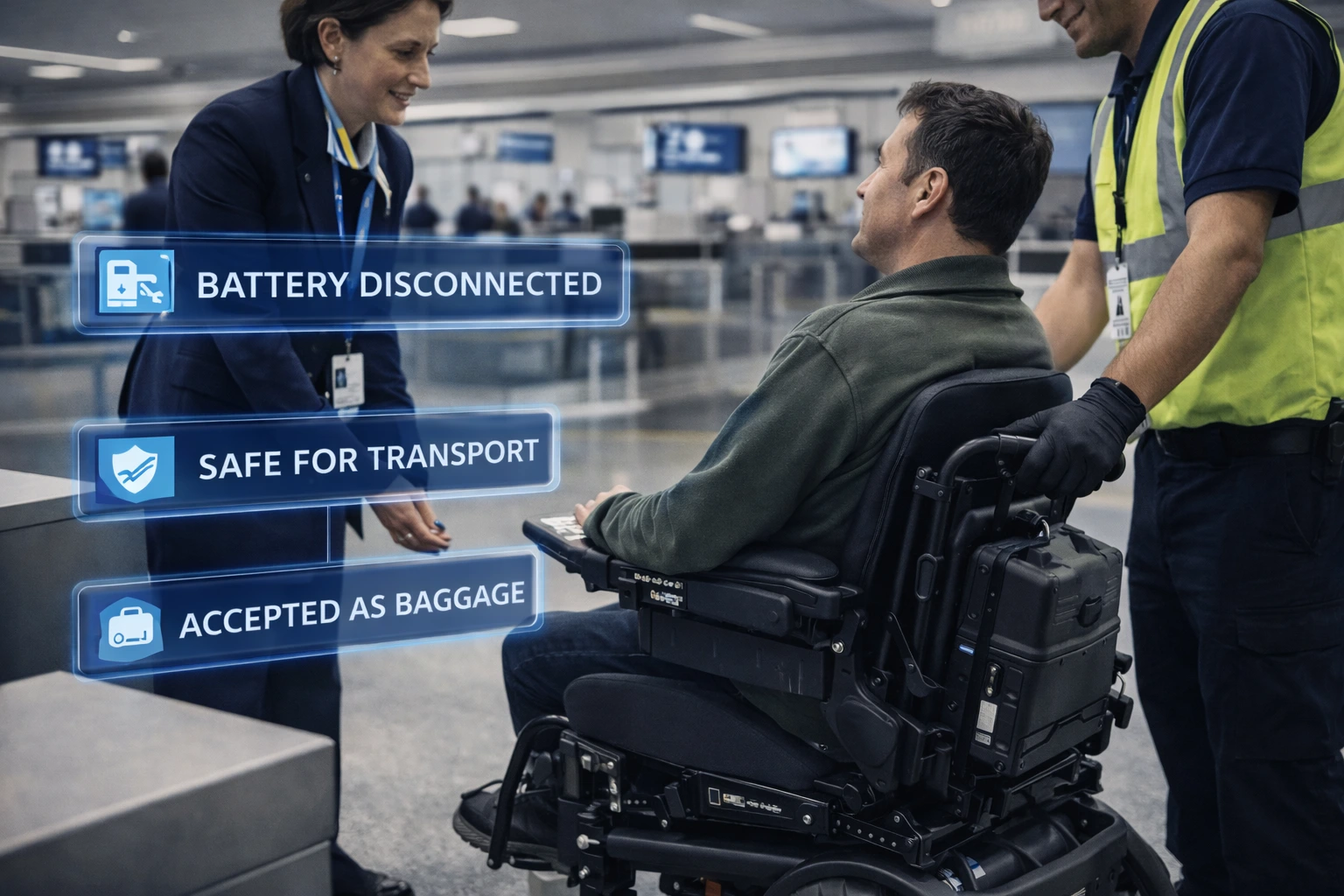
    Ground staff disconnecting battery terminals on powered wheelchair
    Figure 1: Battery disconnection and inspection ensure mobility aids are safe for air transport.

    Purpose and Context

    The purpose of Resolution 745b is to unify airline policies for the acceptance of mobility aids, particularly those powered by batteries. Prior to its implementation, airlines applied varying rules, creating uncertainty and inconsistency for passengers.

    The resolution establishes that mobility aids are not optional baggage items but essential equipment that must travel with the passenger. If the device cannot be accommodated in the cabin, it must be transported in the cargo hold under controlled conditions.

    This approach aligns operational procedures with accessibility principles, ensuring that passengers with reduced mobility receive consistent and reliable service across the aviation network.

    Accessibility in aviation means ensuring essential mobility equipment always travels with the passenger.

    Key Provisions

    Resolution 745b defines specific technical conditions that must be met before a mobility aid can be accepted for transport. These provisions ensure that battery-powered equipment does not pose a safety risk during flight.

    • Battery disconnection: The main battery must be completely disconnected or electrically isolated.
    • Terminal insulation: Battery terminals must be protected to prevent short circuits.
    • Secure attachment: The battery must remain securely attached to the mobility aid frame.
    • Marking and labeling: The equipment must be clearly identified and labeled according to safety requirements.

    These requirements mirror broader aviation safety standards and ensure that mobility aids can be transported safely within the aircraft environment.
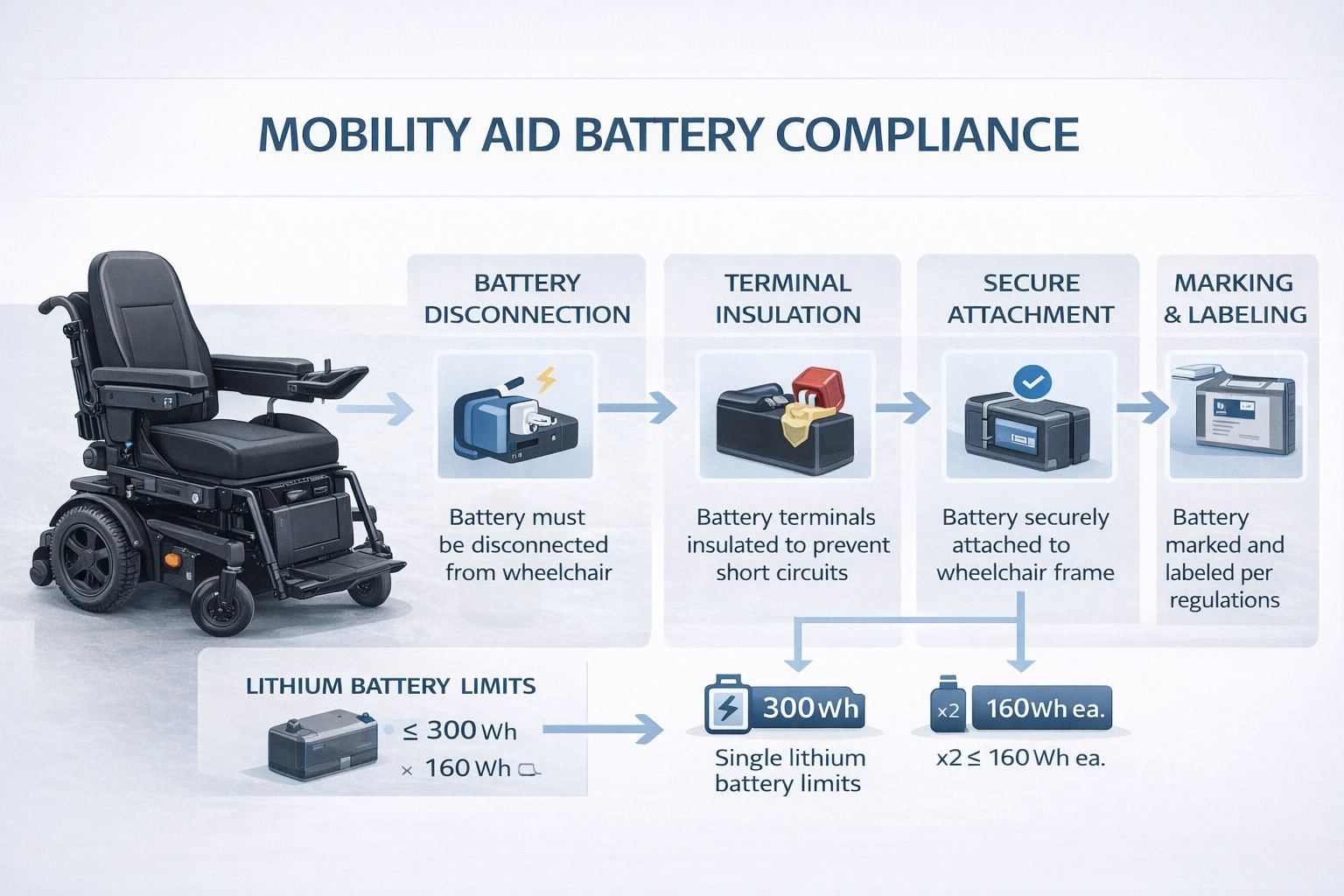
    Infographic showing battery compliance for mobility aids
    Figure 2: Mobility aid transport requires battery disconnection, insulation, secure attachment, and proper labeling.

    Implementation Guidelines

    Airlines implement Resolution 745b through structured operational procedures involving check-in staff, ground handlers, and ramp teams. At check-in, staff must identify the mobility aid, confirm its type, and ensure that all safety requirements are met.

    The battery is then handled according to its type. For some devices, removable batteries may be carried separately in the cabin, while the wheelchair itself is transported without the battery. For non-removable batteries, the device must be secured and prepared according to safety procedures.

    Once accepted, the mobility aid is tagged, documented, and transferred to the aircraft under controlled handling conditions. Ground staff use specialized equipment such as lifting devices to move and load the aid safely.

    Handling and Aircraft Loading

    During loading, mobility aids must be secured to prevent movement and damage. They are typically positioned upright and restrained using straps or other securing methods.

    Special care is taken to ensure that the device is not damaged during handling. This includes avoiding improper positioning, such as placing the aid on its side, and protecting it from other baggage.

    These procedures ensure both safety and preservation of the equipment, which is often highly customized and essential to the passenger.
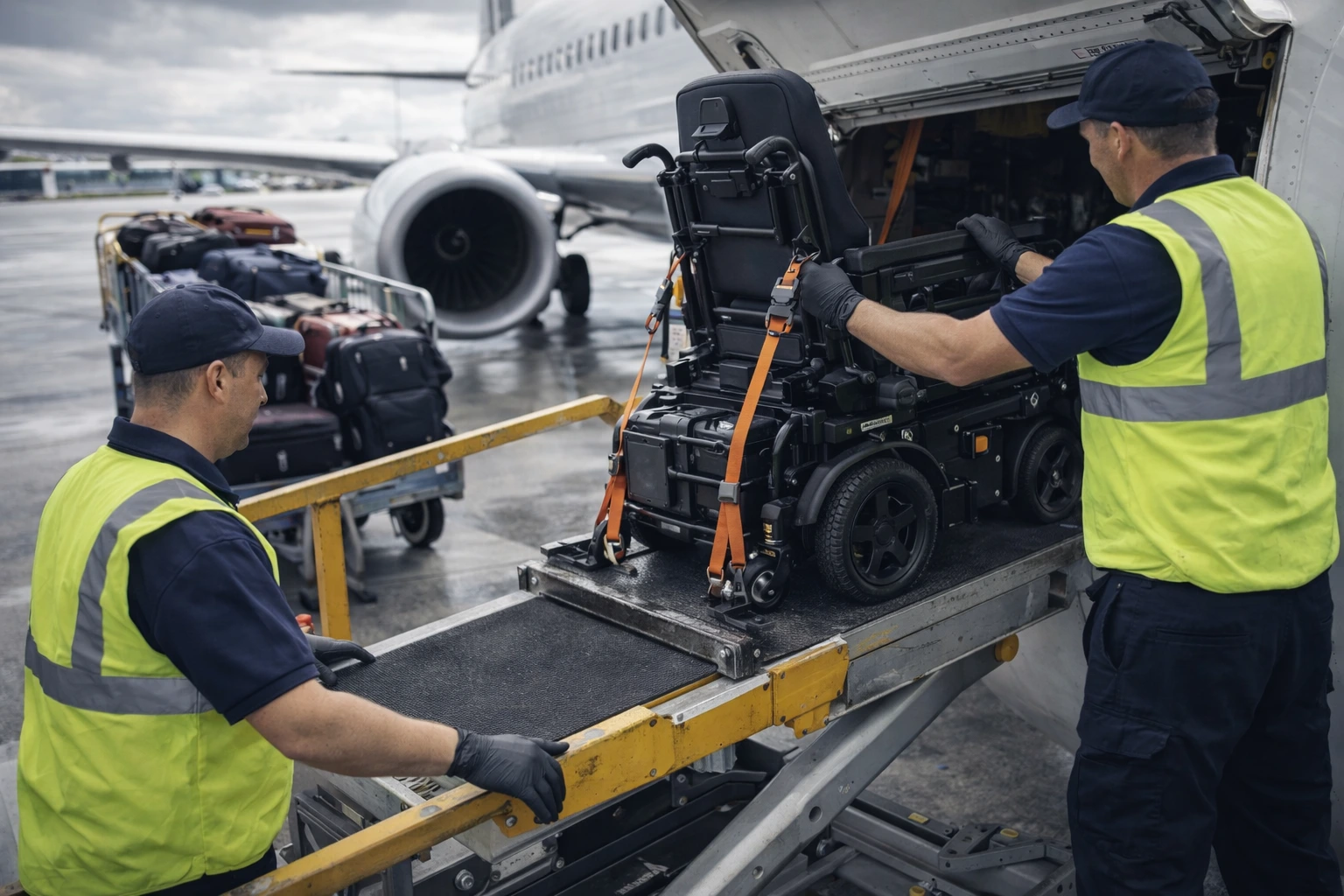
    Ground crew loading powered wheelchair into aircraft cargo hold
    Figure 3: Mobility aids are carefully loaded and secured in the aircraft cargo hold to prevent damage.

    Operational Benefits

    Standardizing mobility aid handling provides clear benefits for both airlines and passengers. For passengers, it ensures predictable service and eliminates uncertainty when traveling across multiple carriers.

    For airlines, it reduces operational ambiguity by providing clear rules for acceptance and handling. This minimizes errors, improves efficiency, and ensures compliance with safety regulations.

    The resolution also supports interline travel by ensuring that mobility aids can be transferred between airlines under consistent conditions.

    Auditability and Compliance

    Resolution 745b is highly auditable due to its clearly defined technical requirements. Airlines can demonstrate compliance through documented procedures, staff training records, and handling protocols.

    Audits typically verify that batteries are properly disconnected, terminals insulated, and devices correctly labeled and secured. These checks ensure that the resolution is consistently applied across operations.

    Real-World Use Case

    A typical scenario involves a passenger traveling with a powered wheelchair across multiple flights. At check-in, the wheelchair is inspected, the battery is disconnected and secured, and the device is tagged for transport.

    As the passenger connects to another airline, the standardized rules ensure that the wheelchair is accepted without additional checks or refusals. Upon arrival, the wheelchair is returned promptly, ready for use.

    This seamless process demonstrates how Resolution 745b ensures both accessibility and operational efficiency.

    Conclusion

    Resolution 745b establishes a critical balance between safety and accessibility in aviation. By standardizing the handling of mobility aids, it ensures that essential equipment travels with the passenger under controlled and secure conditions.

    Its impact extends across the aviation system, improving consistency, reducing operational risks, and enhancing the travel experience for passengers who rely on mobility aids. In doing so, it reinforces the principle that accessibility is not optional—it is a fundamental part of modern air travel.

    Share. Facebook Twitter Pinterest LinkedIn Tumblr Email
    Previous ArticleResolution 746 – Pooling of Baggage
    Next Article IATA Resolution 745a-Firearms and Weapons in Checked Baggage
    yousuccess
    • Website

    Related Posts

    Resolution 744 – Local Baggage Committees

    January 14, 2021
    7.2

    Resolution 745 – Dangerous Goods in Passengers’ Baggage

    January 14, 2021

    IATA Resolution 745a-Firearms and Weapons in Checked Baggage

    January 14, 2021
    Demo
    Latest Posts

    IATA Resolution 751 – Use of the 10-Digit License Plate

    March 10, 202215 Views

    IATA Resolution 752 – Electronic Baggage Claim Receipt

    March 10, 202216 Views

    IATA Resolution 753 – Baggage Tracking

    March 10, 202215 Views

    IATA Resolution 754 – Baggage Proration Profiles

    March 10, 20226 Views
    Stay In Touch
    • Facebook
    • Twitter
    • Pinterest
    • Instagram
    • YouTube
    • Reddit
    Don't Miss

    Navitaire New Skies

    By yousuccessJanuary 14, 2021

    Market Position and Product Profile Navitaire New Skies is an integrated Passenger Service System designed…

    Radixx Res

    January 17, 2021

    IATA Resolution 743c – On‑Hand Baggage Summary Tag

    January 10, 2020

    Subscribe to Updates

    Get the latest news about Baggage and Trends to keep pace with aviation.

    Demo
    About Us
    About Us

    The aviation industry's trusted baggage resource. Discover expert articles, technical guidance, IATA baggage standards, operational best practices, baggage systems, and professional training designed to help airlines, airports, and ground handlers improve baggage performance, compliance, and the passenger experience.

    Need baggage expertise? We're available for consulting, training, operational audits, baggage system implementation support, and strategic partnerships.

    Email: [email protected]


    WhatsApp Us

    Facebook X (Twitter) Instagram Pinterest YouTube WhatsApp
    Our Picks

    IATA Resolution 751 – Use of the 10-Digit License Plate

    March 10, 2022

    IATA Resolution 752 – Electronic Baggage Claim Receipt

    March 10, 2022

    IATA Resolution 753 – Baggage Tracking

    March 10, 2022
    Most Popular

    Navitaire New Skies

    January 14, 202121 Views

    Radixx Res

    January 17, 202120 Views

    IATA Resolution 743c – On‑Hand Baggage Summary Tag

    January 10, 202017 Views
    © 2026 Baggage Logistics. Designed by Baggage Logistics.
    • Home
    • Passenger Services
    • Interline & Passenger Communications
    • Baggage Operations
    • Buy Now

    Type above and press Enter to search. Press Esc to cancel.