


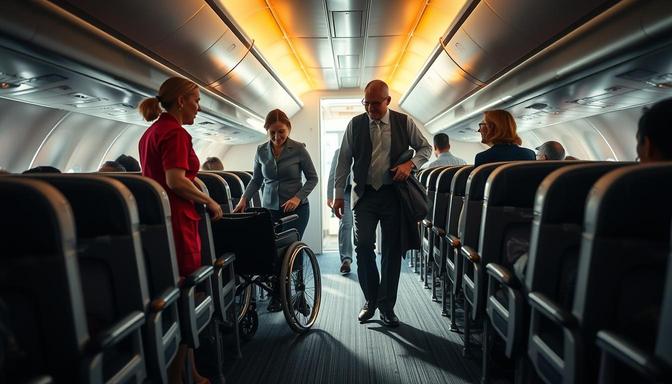
Recommended Practice 1700c (Passenger Services Conference, IATA), formally designated PSC(30)1700c, is the industry recommended practice that governs seat assignment for passengers with disabilities (PWD), passengers with reduced mobility (PRM), and their safety assistants (also referred to as escorts). It is classified as Type B and carries an indefinite expiry. The practice was updated as part of the Passenger Accessibility Process Task Force (PAPTF) work under the Travel Standards Board, with changes submitted and adopted through the Passenger Standards Conference processes (notably the 2021 cycles).
Its core purpose is to ensure that seat assignments for PWDs and their safety assistants facilitate boarding and disembarkation, minimise inconvenience to the passenger, and maximise the opportunity for cabin crew assistance, while strictly observing aircraft safety requirements. It operates in conjunction with Resolution 700 (Acceptance and Carriage of Passengers Requiring Special Assistance) and related recommended practices such as 1700b (Carriage of Passengers with Disabilities and Safety Assistant Requirements).
To simplify terminology while remaining inclusive, the practice adopts “Passengers with Disabilities (PWD)” as the official term. It applies equally to passengers with reduced mobility (PRM) and passengers with non-visible (hidden) disabilities. Disability is understood in the broad sense used in Resolution 700: individual functioning that includes physical, sensory, cognitive, intellectual, mental health, neurodevelopmental, and certain chronic conditions.
Origin, Status, and Relationship to Other Standards
RP 1700c sits within the suite of IATA passenger accessibility standards. Resolution 700 provides the overarching framework for acceptance and carriage. RP 1700b addresses when a safety assistant is required and the conditions of carriage. RP 1700c focuses specifically on seating. Later related practices cover group travel (1700d) and publication of rates/conditions (1700e).
The practice is indefinite in duration. Updates occur through PSC votes or amendment processes. A significant modernisation effort occurred around 2021 via the PAPTF, aligning terminology from older “reduced mobility/escorts” language toward “disabilities/safety assistants,” clarifying definitions, and ensuring consistency with contemporary regulatory expectations (including U.S. Air Carrier Access Act/14 CFR Part 382, EU Regulation 1107/2006, EASA rules on special categories of passengers, and ICAO guidance).
Like other Type B recommended practices, it is not strictly mandatory in the same way as a Resolution, but once adopted it provides strong industry guidance that member airlines are expected to implement in their operating manuals, reservation systems, and ground/cabin procedures. Compliance is routinely audited through internal quality systems, Local Baggage/Passenger Committees where relevant, and regulatory oversight.
Purpose and Scope
The primary purpose is dual: passenger-centred accommodation and absolute safety. Seats must be assigned within the passenger’s ticketed cabin class so that:
- Boarding and disembarkation are facilitated.
- Inconvenience to the PWD is minimised.
- Cabin crew can provide the maximum practicable assistance.
- Emergency evacuation is never impeded.
- Crew duties and access to emergency equipment remain unobstructed.
As a general rule, PWDs shall not normally be restricted to any particular cabin or seating area solely because of their disability (consistent with Resolution 700). However, safety rules take precedence. Passengers must not be allocated or occupy seats where their presence could impede emergency evacuation of the aircraft, impede crews in their duties, or obstruct access to emergency equipment.
Safety assistants must be seated immediately adjacent to the passenger they are accompanying. Seat assignment should best accommodate the passenger’s specific needs and may also be subject to medical requirements. When oxygen is used, smoking is not permitted in the relevant area.
The practice applies to interline and online carriage. It interacts with Special Service Request (SSR) codes (e.g., WCHR, WCHS, WCHC, BLND, DEAF, DPNA, MAAS, and others defined under Resolution 700), advance seat reservation systems, and day-of-travel procedures.
Technical Structure and Key Provisions
RP 1700c is structured with general principles followed by specific seat assignment guidelines.
1. General
- PWDs shall not normally be restricted to particular cabins or seating areas.
- Specific seats within the ticketed cabin shall be assigned to facilitate boarding/disembarkation, minimise inconvenience, and maximise cabin-crew assistance.
- Seats must not impede emergency evacuation, crew duties, or access to emergency equipment.
- Safety assistants receive immediately adjacent seats.
- Assignment should best meet the passenger’s needs (and any medical requirements).
- Oxygen use precludes smoking.
2. Seat Assignment Guidelines When assigning seats, members shall observe the following criteria (summarised from the practice text and aligned industry implementation):
- Blind or deaf passengers travelling with service animals (specially trained dogs or other approved animals) should be assigned seats that allow space for the animal on the floor surrounding the seat, preferably near a floor-level exit but without impeding access to the exit or crew duties.
- Passengers with mobility problems should be seated so as not to impede rapid evacuation. Where requested and feasible, seats near toilets and floor-level exits equipped with escape slides/chutes are preferred.
- Exit-row seats are generally prohibited for passengers who cannot perform the required exit-row functions (mobility, strength, dexterity, ability to understand and follow commands, etc.), consistent with national aviation authority rules (e.g., FAA 14 CFR 121.585, EASA equivalent).
- Passengers requiring movable aisle armrests (for transfer from an aisle chair) should be assigned such seats when available in the class of service purchased.
- Passengers with a fused or immobilised leg should receive bulkhead or other seats offering additional legroom when available and requested.
- Passengers travelling with a service animal may request bulkhead or non-bulkhead seating as appropriate, subject to safety rules and space.
- Safety assistants / personal care attendants / readers / interpreters required under Resolution 700 or applicable law must receive adjoining seats.
These guidelines are implemented subject to the aircraft configuration, class of service purchased, and applicable government safety regulations. Airlines are not required to provide a seat in a higher class of service or more than one seat per ticket solely because of disability, unless local law or the carrier’s own policy provides otherwise.
Implementation in Airline Operations
Airlines incorporate RP 1700c into:
- Reservation system logic and SSR handling (advance seat maps, blocked or priority seats).
- Check-in and gate procedures (early check-in recommendations for complex assistance, verification of SSR codes, re-accommodation on equipment changes).
- Cabin crew training and briefing (individual safety briefings for special category passengers where needed, awareness of adjacent seating for assistants).
- Ground handling manuals and airport local procedures.
- Website and app information (clear description of seating policies, how to request accommodations, conditions under which a safety assistant is required).
Two common methods exist for advance seat assignment systems (aligned with U.S. DOT guidance and widely used internationally):
- Block method: An adequate number of qualifying seats (movable armrest, adjoining, bulkhead/legroom, service-animal suitable) are blocked until close to departure and released only to eligible passengers or last-minute general sale.
- Priority method: Seats are designated as priority; eligible passengers receive preference, often with a requirement to request more than 24 hours in advance or to check in early.
Where advance assignment is not offered, pre-boarding allows eligible passengers to select appropriate seats subject to safety rules.
Safety assistants are defined (consistent with updated Resolution 700 language) as persons at least 16 years old (or the age required by local legislation) who are physically and mentally able and willing to assume responsibility for the PWD in an emergency. Personal care attendants provide in-flight personal needs assistance that cabin crew are not required to perform.
Responsibilities, Safety, and Cost Considerations
The operating carrier retains ultimate responsibility for safe seating. The commander’s authority on safety matters is final. Refusal of carriage or of a specific seat occurs only on safety grounds after full assessment of the passenger’s abilities and available mitigations, and in accordance with applicable law (e.g., EU 1107/2006 Article 4, ACAA).
Cost recovery for any extra seat required for a safety assistant is governed by the carrier’s published conditions and by RP 1700e (publication of rates and conditions). Many carriers offer free or discounted seats for required safety assistants under defined circumstances; others apply standard fares. Clear publication is essential for transparency.
Benefits for Passengers and Airlines
For passengers: greater predictability, reduced physical strain during boarding and in flight, ability to sit with necessary assistants or service animals, and dignity through non-discriminatory yet safety-compliant seating. For airlines: standardised procedures reduce day-of-travel disputes, improve evacuation readiness, lower the risk of regulatory findings or complaints, and support consistent interline handling. Clear rules also reduce last-minute reseating and associated operational disruption.
Auditability and Compliance
Compliance is demonstrated through:
- PNR/SSR records showing advance requests and assigned seats.
- Reconciliation of blocked/priority seat inventories.
- Cabin crew reports and individual briefings.
- Equipment-change re-accommodation logs.
- Training records and quality audits.
- Alignment with national regulations (FAA, EASA, CAA, etc.) and ICAO Manual on Access to Air Transport by Persons with Disabilities.
Data analytics on SSR volumes, seat utilisation, and complaint rates further support continuous improvement.
Real-World Application Examples
- A passenger using an aisle chair who cannot transfer over a fixed armrest is assigned a movable-aisle-armrest seat in the purchased class; the safety assistant (if required) sits immediately adjacent.
- A blind passenger travelling with a trained service dog is offered a bulkhead seat or other seat with floor space for the animal, near but not blocking a floor-level exit.
- A passenger with a fused leg receives a bulkhead or extra-legroom seat when available and requested in advance.
- On an equipment change, the airline reassigns the passenger to an equivalent suitable seat rather than a random open seat.
- Exit-row seats remain reserved for able-bodied passengers capable of performing the required functions.
Conclusion
Recommended Practice 1700c provides the practical seating framework that turns the high-level principles of Resolution 700 into day-to-day operational reality. By requiring seats that facilitate boarding and assistance while rigorously protecting evacuation capability and crew effectiveness, it balances accessibility with the non-negotiable demands of aviation safety. When implemented consistently—through reservation systems, staff training, clear passenger information, and interline coordination—it reduces inconvenience for passengers with disabilities, clarifies responsibilities for airlines, and strengthens the overall reliability of the passenger accessibility system.
Sources for this description include the published text of RP 1700c as amended through the 2021 Passenger Standards Conference processes, IATA Guidance on the Transport of Mobility Aids, related Resolution 700 language, and aligned regulatory frameworks (U.S. DOT ACAA seating rules, EASA special category passenger guidance, ECAC Doc 30, ICAO accessibility manual). Full proprietary IATA manuals remain the definitive reference for member airlines.
