



Resolution 709 governs the Baggage Transfer Message (BTM), an IATA Passenger Services Conference Type-B message used to report interline baggage transfers between airlines. In operational terms, once a flight arrives, the delivering carrier sends a BTM to the next carrier in the passenger’s itinerary, listing the checked baggage that will continue on onward sectors.
This process allows the receiving carrier’s baggage system to be updated automatically with the expected bag tag numbers, routing details, and connecting flight information. By standardizing this transfer data, BTMs reduce mishandling, minimize routing errors, and improve accountability in interline baggage operations.
By enforcing a common message standard, Resolution 709 helps airlines exchange baggage data reliably, improving efficiency and customer satisfaction in baggage transfers.
IATA baggage messaging framework
A Standard for Interline Baggage Control
Resolution 709 was originally adopted by the IATA Passenger Services Conference under PSC(22) and took effect on 1 January 2002. In the IATA Passenger Services Conference Resolutions Manual, the resolution states that for the carriage of interline baggage, members must use and transmit the Baggage Transfer Message as defined in Recommended Practice 1745/ATA 30.45, Section 3.
Since its introduction, the resolution has remained materially unchanged. Published conference manuals and amendment records indicate that Resolution 709 has continued in force in its original form, making it one of the enduring technical standards within the interline baggage framework.

Technical Structure and Messaging
Resolution 709 requires BTMs to be transmitted using the Type-B airline messaging format. Type-B remains one of the most widely used operational message protocols in commercial aviation, especially for legacy yet mission-critical exchanges between airline systems, airport systems, and service providers.
The detailed technical structure of the BTM is defined in IATA/ATA Recommended Practice 1745, Section 3. This document forms part of the Baggage Information Messages standard and defines the sequence, syntax, and data elements for standardized baggage-related messages.
Within that suite, the BTM appears alongside several other baggage message types, including the Baggage Source Message, Baggage Processed Message, Baggage Unload Message, Baggage Not Seen Message, Baggage Control Message, Baggage Manifest Message, and Baggage Request.
- BTM – Baggage Transfer Message: Reports all baggage tags transferring from one carrier to the next for onward carriage.
- BSM – Baggage Source Message: Sent at check-in with the initial baggage details.
- BPM – Baggage Processed Message: Confirms that a bag has been processed or loaded in the baggage system.
- BUM – Baggage Unload Message: Indicates that a bag has been offloaded from a flight.
- BNS – Baggage Not Seen Message: Alerts the system that a bag expected on a flight was not seen.
- BCM – Baggage Control Message: Used for operational control and exception handling.
- BMM – Baggage Manifest Message: Provides a manifest of baggage associated with a specific flight.
- BRQ – Baggage Request: Used to request baggage information for tracing or follow-up.
In practical use, a BTM contains structured fields such as connecting flight number, date, number of bags, and the bag tag license plate numbers associated with the transfer. Because RP 1745 standardizes the message format, receiving systems can parse and validate the message consistently across airlines and airports.
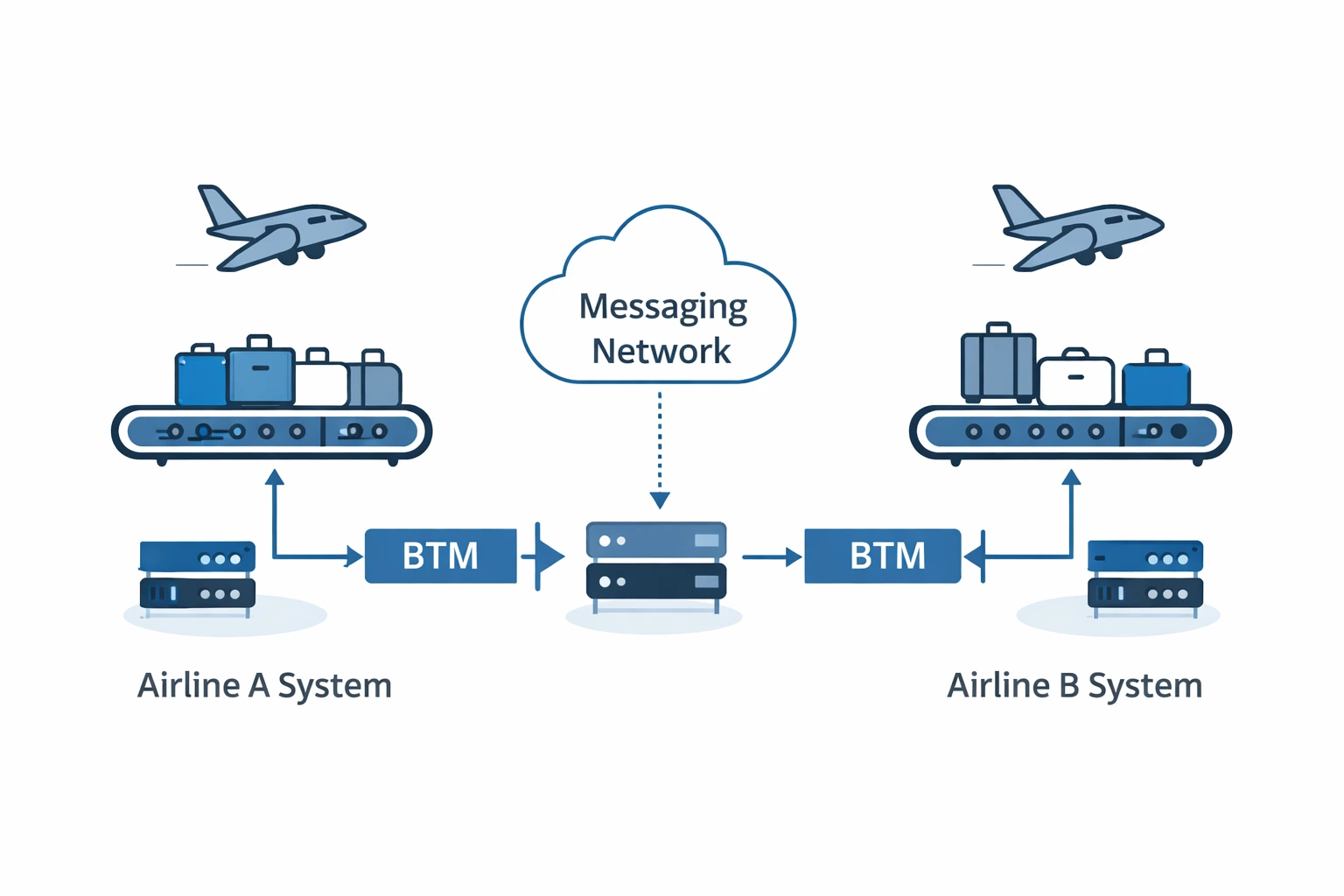
Implementation Guidelines
From an implementation standpoint, Resolution 709 requires baggage or departure-control systems to generate BTMs automatically after flight operations produce transfer baggage data. The objective is not manual notification, but automated and timely system-to-system exchange.
- Identify all checked baggage transferring to another carrier or onward service.
- Generate a BTM using the required data structure and message elements defined in RP 1745.
- Transmit the message through a Type-B network such as SITA or ARINC to the receiving carrier’s designated address.
- Ensure bilateral message testing confirms that syntax, routing, and system interpretation are correct.
In a typical operating environment, once a flight lands and transfer baggage is identified, the carrier’s system compiles the relevant bag tag numbers and onward flight details into a BTM. That message is then sent to the next carrier, whose baggage system uses it to anticipate, reconcile, and route the transfer bags accurately.
Benefits to Airlines and Passengers
The most immediate benefit of the BTM is a reduction in baggage mishandling. Because the receiving carrier knows which bags to expect and where they should be routed, the chance of transfer baggage being missed, delayed, or misdirected is significantly reduced.
BTMs also strengthen customer service performance. When bags fail to make a connection, the messaging chain helps airlines detect the issue quickly and trigger follow-up actions such as baggage tracing or exception messaging. This improves communication, shortens response time, and supports faster claim resolution.
Another important advantage is traceability. Every standardized transfer message creates an auditable operational record, allowing airlines and auditors to determine which carrier transferred which bags, when the message was sent, and how the baggage flow was handled across multiple sectors.
Why Resolution 709 matters in practice:
- Improves interline baggage accuracy and continuity.
- Reduces missed transfer bags and handling errors.
- Supports automated baggage reconciliation for onward flights.
- Creates a reliable audit trail for baggage flow and compliance review.
Auditability and Compliance
As an IATA Resolution, 709 forms part of the standards framework governing interline baggage cooperation among member carriers. Compliance is not merely technical; it is operationally significant because missing or malformed BTMs can disrupt downstream baggage handling and create disputes between carriers.
For this reason, airlines commonly log every BTM sent and received. These records can be compared against flight activity, baggage logs, and passenger itineraries during internal reviews, service audits, or partner investigations. Because the format is standardized, the audit trail is consistent across systems and operators.
Real-World Use Cases
Consider a passenger traveling from Airport A to Airport C via Airport B, with Carrier X operating the first sector and Carrier Y operating the second. When Carrier X’s flight arrives at Airport B, its system generates a BTM listing the bag tags of all passengers connecting onto Carrier Y. Carrier Y’s baggage system then uses that data to prepare for loading those transfer bags onto the onward flight.
If one of the bags fails to arrive at the transfer point, the receiving carrier can compare the physical baggage flow against the received BTM and identify the discrepancy quickly. That enables exception handling, reconciliation, and baggage tracing actions with much less delay than manual investigation would require.

Conclusion
Resolution 709 remains a core standard in modern interline baggage operations. First adopted under PSC(22) and effective from 1 January 2002, it established the Baggage Transfer Message as the industry mechanism for communicating interline baggage transfers in a structured, reliable, and auditable way.
Its continued relevance lies in its simplicity and interoperability. By requiring carriers to exchange consistent baggage transfer data through the Type-B framework defined in Recommended Practice 1745, Resolution 709 supports efficient baggage handling, stronger accountability, and better outcomes for both airlines and passengers.
Sources: IATA baggage standards, Recommended Practice 1745, and Passenger Services Conference Resolution references as reflected in the source material.
