


Introduction
Over the past two decades, the airline industry has undergone a significant transformation in passenger processing. Traditional check-in counters, once the sole point for issuing boarding passes and accepting checked baggage, have increasingly been complemented—or replaced—by self-service technologies. Online check-in, mobile boarding passes, Common Use Self-Service (CUSS) kiosks, biometric identity verification, and automated baggage drop systems have become standard features at many airports worldwide. These innovations are designed to reduce passenger waiting times, improve airport efficiency, and lower operating costs while maintaining security and baggage accountability.
One of the most important developments in this transformation has been the introduction of self-service baggage check-in, commonly referred to as self-bag-drop. Under this operating model, passengers perform many of the activities previously handled by airline agents. Depending on the implementation, passengers may check in online or at a kiosk, print their own baggage tags, attach the tags themselves, and deposit their baggage at an automated baggage-drop station with little or no airline staff assistance.
To ensure that these increasingly common systems operate consistently throughout the global aviation industry, the International Air Transport Association (IATA) developed Recommended Practice (RP) 1701f – Self-Service Baggage Check-In. The Recommended Practice establishes internationally recognized best-practice guidance covering the complete self-service baggage process—from baggage registration and tag issuance through baggage acceptance, messaging, signage, and systems integration. Although not mandatory, RP 1701f provides a standardized framework that enables airlines, airports, technology providers, and ground handlers to implement compatible self-service baggage solutions while maintaining interoperability across the worldwide air transport network.
RP 1701f was developed as part of IATA’s broader Fast Travel initiative, which sought to give passengers greater control over their journey while improving operational efficiency for airlines and airports. Rather than requiring every airline or airport to design independent self-baggage procedures, the Recommended Practice defines common operational workflows, standardized baggage tagging procedures, recommended user interfaces, and messaging requirements that support a consistent passenger experience regardless of the airport or airline involved. This harmonized approach reduces implementation complexity while encouraging widespread adoption of self-service technologies.
A defining feature of RP 1701f is its continued reliance on existing IATA baggage identification standards. Although passengers assume responsibility for printing and attaching baggage tags, the baggage itself remains fully integrated into traditional airline baggage management systems. Every self-printed baggage tag contains the standard ten-digit License Plate Number (LPN), allowing the bag to be identified, sorted, tracked, reconciled, and traced using the same operational infrastructure employed for agent-accepted baggage. The Recommended Practice therefore modernizes passenger interaction without changing the underlying baggage identification architecture.
The Recommended Practice also addresses an important operational requirement: maintaining complete baggage accountability. Self-service processing does not eliminate the need for security, reconciliation, or auditability. Instead, RP 1701f specifies that baggage acceptance must remain fully integrated with Departure Control Systems (DCS), automated baggage handling systems (BHS), and IATA baggage messaging standards. When a passenger deposits baggage at a self-service station, the system validates the boarding pass, confirms the baggage tag, activates the License Plate Number, and generates the appropriate operational messages that allow the baggage to be tracked throughout its journey. This preserves the same level of operational visibility as traditional staffed check-in.
Another important objective of RP 1701f is passenger consistency. Self-service baggage facilities are increasingly deployed at airports serving multiple airlines, often through Common Use Self-Service (CUSS) environments. Without common standards governing tag printing, kiosk behaviour, user interfaces, and baggage acceptance procedures, passengers would encounter different processes at each airport or airline. RP 1701f addresses this challenge by recommending standardized signage, common baggage tag stock, consistent workflow sequencing, and interoperable data interfaces, allowing passengers to experience similar self-service processes regardless of location.
Today, self-service baggage check-in has become a core component of modern airport operations. Major international hubs—including those operated by airlines such as Lufthansa, Singapore Airlines, and Qantas—have deployed automated baggage drop facilities based on the principles established by RP 1701f. As airports continue investing in automation, biometric processing, RFID baggage identification, and digital passenger journeys, the Recommended Practice remains one of the industry’s most important guidance documents for implementing efficient, secure, and interoperable self-service baggage systems.
[Hero Image]
Caption
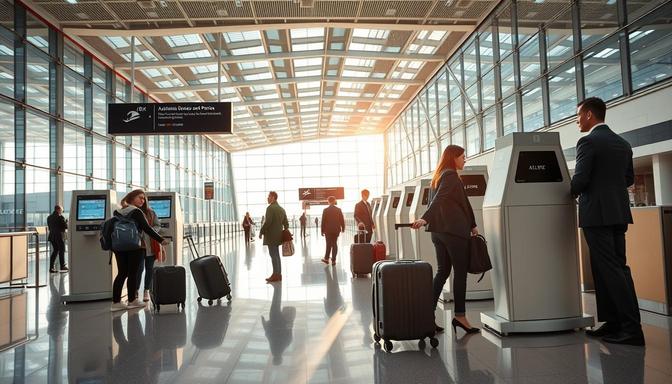
Figure 1: Passengers using a modern self-service baggage drop area equipped with Common Use Self-Service (CUSS) kiosks, automated bag-drop units, self-printed baggage tags, barcode scanners, baggage weighing systems, and integrated baggage handling conveyors. Airline Departure Control Systems and automated baggage tracking platforms monitor the transaction in real time, illustrating the standardized self-service workflow defined by IATA RP 1701f.
Origin and Publication
The Need for Standardized Self-Service Baggage Processing
As passenger numbers increased throughout the early 2000s, airlines and airports faced growing pressure to process larger volumes of travellers without proportionally expanding terminal space or staffing levels. Traditional staffed check-in counters became operational bottlenecks during peak periods, contributing to long queues, higher operating costs, and inconsistent passenger experiences.
At the same time, advances in self-service technology—including online check-in, kiosk-based boarding pass issuance, and automated baggage handling—created opportunities to transfer routine check-in activities from airline agents to passengers themselves. Self-service baggage check-in emerged as a logical extension of these developments, allowing passengers to print and attach baggage tags independently before depositing their baggage at automated drop-off stations.
While the technology matured rapidly, implementation practices varied significantly between airlines and airports. Differences in kiosk interfaces, baggage tag formats, operational workflows, and systems integration created inconsistencies that reduced interoperability and complicated passenger use. RP 1701f was developed to address these challenges by establishing internationally recognized best practices governing the complete self-service baggage process.
Development Under the Fast Travel Initiative
RP 1701f was developed as part of IATA’s Fast Travel programme, an industry initiative designed to simplify passenger processing through greater automation and self-service.
Fast Travel identified several passenger services suitable for automation, including:
- self-service check-in;
- self-service baggage drop;
- automated document verification;
- self-service flight rebooking;
- automated boarding.
Within this programme, RP 1701f specifically addressed self-service baggage check-in by providing standardized operational guidance that could be adopted globally while remaining compatible with existing baggage handling infrastructure.
Passenger Services Conference
RP 1701f was formally adopted by the IATA Passenger Services Conference (PSC) at its 31st meeting in Geneva in October 2009. Following its approval, the Recommended Practice was incorporated into the 30th Edition of the Passenger Services Conference Resolutions Manual, which became effective in June 2010. Since that time, the Recommended Practice has remained part of the IATA passenger services framework and continues to guide industry implementation of self-service baggage technologies.
Unlike mandatory Passenger Services Conference Resolutions, RP 1701f is advisory rather than compulsory. Nevertheless, its recommendations have been widely adopted because they provide a practical implementation framework that simplifies deployment while encouraging compatibility between airlines, airports, and technology providers.
Scope of the Recommended Practice
RP 1701f governs the complete operational process associated with self-service baggage acceptance.
Its scope extends beyond simple baggage tag printing and includes:
- baggage registration;
- self-tagging;
- baggage acceptance (fast bag drop);
- baggage messaging;
- passenger guidance and signage;
- operational terminology.
The Recommended Practice therefore covers the entire passenger interaction from the moment baggage is declared until it enters the automated baggage handling system.
Relationship with Existing Baggage Standards
Although RP 1701f introduces new passenger-facing procedures, it deliberately preserves compatibility with existing IATA baggage standards.
The Recommended Practice relies upon:
- the standard ten-digit License Plate Number (LPN);
- IATA baggage tag specifications;
- baggage messaging under RP 1745;
- Departure Control System integration;
- automated baggage handling processes.
Rather than replacing existing baggage identification methods, RP 1701f adapts them for self-service operation while maintaining operational continuity across the industry.
Continuous Evolution
Since its introduction, RP 1701f has remained aligned with developments in passenger self-service technologies.
Its principles continue supporting newer innovations, including:
- biometric passenger identification;
- mobile check-in;
- Common Use Passenger Processing Systems (CUPPS);
- RFID baggage identification;
- off-airport baggage acceptance.
Although technology has advanced considerably since the Recommended Practice was first adopted, its core operational framework continues to provide the foundation for modern self-service baggage check-in systems.
Purpose
Standardizing Self-Service Baggage Processing
The primary purpose of RP 1701f is to establish internationally recognized best practices for self-service baggage check-in.
By defining standardized operational workflows, the Recommended Practice enables airlines and airports to deploy compatible self-service baggage solutions that deliver a consistent passenger experience while maintaining interoperability with existing baggage systems.
Supporting Passenger Self-Service
RP 1701f encourages greater passenger participation in the baggage check-in process by providing guidance covering:
- baggage registration;
- baggage tag printing;
- baggage tag attachment;
- automated baggage acceptance.
The objective is to reduce dependence on staffed check-in counters while preserving operational reliability.
Maintaining Baggage Accountability
Although passengers assume greater responsibility for baggage tagging, RP 1701f ensures that baggage remains fully traceable throughout its journey.
Every baggage tag incorporates the standard ten-digit License Plate Number, allowing automated baggage systems to identify, track, reconcile, and trace baggage using existing operational processes.
Supporting Airport Efficiency
Self-service baggage processing reduces passenger queues while enabling airlines to redeploy staff toward more complex customer service activities.
RP 1701f therefore supports:
- improved terminal throughput;
- reduced operational costs;
- better utilization of airport facilities;
- faster passenger processing.
Promoting Global Interoperability
Ultimately, RP 1701f exists to ensure that self-service baggage check-in systems deployed anywhere in the world operate according to compatible principles. By standardizing workflows, data interfaces, messaging, baggage identification, and passenger interaction, the Recommended Practice supports a globally consistent self-service baggage environment while maintaining compatibility with the broader IATA baggage standards framework.
Operational Importance
RP 1701f represents one of the aviation industry’s most significant advancements in passenger processing by standardizing self-service baggage acceptance while preserving the integrity of traditional baggage handling systems. Although passengers perform activities that were once handled by airline staff, the Recommended Practice ensures that baggage remains fully integrated into airline operational systems, baggage tracking platforms, and airport baggage handling infrastructure.
The Recommended Practice demonstrates that passenger self-service does not eliminate operational control. Instead, it redistributes responsibilities between passengers, automated equipment, and airline systems while maintaining complete baggage accountability throughout the journey.
Transforming the Passenger Experience
Traditional baggage check-in required passengers to queue at staffed airline counters where an agent:
- verified travel documents;
- checked baggage allowance;
- printed baggage tags;
- attached baggage tags;
- accepted baggage.
RP 1701f restructures this process.
Passengers now perform several of these activities themselves while automated systems complete the remaining operational tasks.
This significantly reduces waiting times while increasing passenger control over the check-in experience.
Supporting Airport Capacity
Modern airports process enormous passenger volumes during peak departure periods.
Expanding terminal facilities or increasing staffing levels is expensive.
Self-service baggage check-in allows airports to increase passenger throughput without proportionally increasing check-in counters.
Benefits include:
- shorter queues;
- faster passenger processing;
- better terminal utilization;
- reduced congestion;
- improved passenger flow.
These operational improvements support long-term airport capacity growth.
Maintaining Baggage Integrity
Although passengers attach baggage tags themselves, baggage integrity remains unchanged.
Every bag continues to receive:
- a standard IATA baggage tag;
- a ten-digit License Plate Number (LPN);
- Departure Control System registration;
- baggage tracking capability;
- automated sortation.
RP 1701f therefore modernizes passenger interaction without altering the underlying baggage identification architecture.
Supporting Fast Travel
RP 1701f forms one component of IATA’s broader Fast Travel initiative.
Together with:
- online check-in;
- mobile boarding passes;
- automated boarding;
- self-service flight rebooking;
- self-service document verification;
self-service baggage drop contributes to an increasingly automated passenger journey.
The Recommended Practice ensures that baggage operations evolve alongside other passenger self-service technologies.
Preserving Security and Accountability
Automation does not reduce aviation security requirements.
RP 1701f requires that baggage acceptance remains fully integrated with airline operational systems.
Before baggage enters the baggage handling system:
- passenger identity is verified;
- boarding credentials are validated;
- baggage tag information is confirmed;
- baggage records are created or updated;
- operational messages are generated.
This preserves the same level of operational accountability as conventional staffed check-in.
Technical Structure
RP 1701f is organized as a procedural standard describing every stage of the self-service baggage process.
Its principal sections include:
- Introduction and Scope
- Baggage Registration
- Self-Tagging
- Baggage Acceptance
- End-to-End Messaging
- Signage
- Glossary
Together these sections define both the passenger experience and the supporting technical architecture.
Section 4.1 — Baggage Registration
The self-service process begins with baggage registration.
This stage determines:
- how many bags the passenger intends to check;
- baggage allowance;
- eligibility for self-service processing.
Depending on implementation, baggage registration may occur:
- during online check-in;
- at a self-service kiosk;
- within the airline mobile application.
For one-step implementations, baggage registration, baggage tag printing, and boarding pass issuance occur during one continuous transaction.
The Recommended Practice also specifies that the same baggage tag stock should be used for both dedicated airline kiosks and Common Use Self-Service (CUSS) kiosks, ensuring consistent passenger processing regardless of the kiosk used.
Section 4.2 — Self-Tagging
After baggage registration, passengers print and attach their own baggage tags.
RP 1701f recommends that:
- baggage tags comply with IATA baggage tag standards;
- tags contain the standard ten-digit License Plate Number;
- tags omit the traditional tear-off baggage claim stub;
- the License Plate Number initially remains inactive until baggage acceptance.
The Recommended Practice further recommends incorporating the License Plate Number into the passenger’s bar-coded boarding pass in accordance with Resolution 792, allowing rapid electronic matching during baggage acceptance.
Ten-Digit License Plate Number (LPN)
The License Plate Number remains the principal baggage identifier.
According to the glossary contained within RP 1701f, the LPN:
- uniquely identifies each baggage tag;
- supports automated baggage sortation;
- supports baggage reconciliation;
- supports baggage delivery;
- supports baggage tracing following mishandling.
The LPN also serves as the primary key linking the physical baggage tag with electronic baggage records and baggage messages.
Section 4.3 — Baggage Acceptance (Fast Bag Drop)
Once the baggage has been tagged, the passenger proceeds to the baggage drop station.
The baggage acceptance process typically includes:
- Presentation of boarding pass or electronic token.
- Scanning of the boarding credential.
- Scanning of the baggage tag.
- Validation of the License Plate Number.
- Matching passenger and baggage.
- Activation of the baggage tag.
- Entry of baggage into the baggage handling system.
The Recommended Practice advises that baggage eligibility—including fees, weight limits, and special baggage requirements—should ideally be verified before baggage reaches the self-drop station in order to avoid delays.
Common Use Self-Service (CUSS)
RP 1701f fully supports Common Use Self-Service environments.
In these airports:
- multiple airlines share kiosks;
- multiple airlines share baggage drop stations;
- airlines continue applying their individual baggage policies;
- common equipment provides standardized passenger interaction.
This interoperability significantly reduces airport infrastructure costs.
Section 5 — End-to-End Messaging
Following successful baggage acceptance, operational messaging begins.
RP 1701f recommends continued use of IATA baggage messaging standards under Recommended Practice 1745.
Typical messages include:
| Message | Purpose |
|---|---|
| BSM (Baggage Source Message) | Records baggage acceptance and source information |
| BPM (Baggage Processed Message) | Confirms baggage processing through baggage systems |
These messages ensure that self-service baggage remains fully integrated with airline operational systems while preserving auditability.
Section 6 — Passenger Signage
Passenger guidance forms an important component of RP 1701f.
The Recommended Practice recommends standardized:
- instructional graphics;
- operational symbols;
- kiosk prompts;
- baggage drop instructions.
Examples include messages such as:
- Scan boarding pass.
- Attach baggage tag.
- Place baggage on belt.
- Wait for confirmation.
Consistent signage improves passenger confidence while reducing assistance requirements.
Section 7 — Glossary
The glossary standardizes terminology used throughout the Recommended Practice.
Key definitions include:
- Agent
- CUSS
- License Plate
- License Plate Number
- Luggage
- Self-Service Baggage
- Fast Bag Drop
The glossary specifically defines the License Plate Number as the unique identifier used throughout automated baggage systems and IATA baggage messaging, ensuring consistent interpretation across the industry.
[Technical Diagram]
Caption
Figure 2: Technical architecture of RP 1701f illustrating the self-service baggage process. The diagram shows online or kiosk baggage registration, self-tag printing, passenger application of the baggage tag, boarding-pass and License Plate Number (LPN) matching at the automated bag-drop unit, validation by the Departure Control System, generation of Baggage Source Messages (BSM) and Baggage Processed Messages (BPM), and transfer into the airport baggage handling system.
Implementation Guidelines
Successful implementation of RP 1701f requires close coordination between airlines, airports, baggage system suppliers, and technology providers.
Airline Responsibilities
Participating airlines should:
- integrate self-service baggage functions into the Departure Control System;
- configure baggage registration workflows;
- support self-tag printing;
- enforce baggage policies;
- generate standard baggage messages;
- maintain License Plate Number integrity.
Airport Responsibilities
Airport operators provide:
- Common Use Self-Service infrastructure;
- baggage drop stations;
- automated conveyor systems;
- barcode scanners;
- baggage weighing systems;
- passenger signage.
Airports also ensure interoperability between multiple participating airlines.
Technology Provider Responsibilities
Manufacturers of:
- CUSS kiosks;
- CUPPS platforms;
- baggage drop systems;
- baggage printers;
- barcode scanners;
- baggage handling systems;
must implement RP 1701f-compatible workflows while supporting IATA baggage standards.
Operational Configuration
Typical implementations require:
- Departure Control System integration;
- Common Use Self-Service compatibility;
- baggage message generation;
- barcode verification;
- baggage reconciliation support;
- baggage handling system connectivity.
These integrations ensure that self-service baggage processing remains fully compatible with traditional airline operations.
Operational Workflow
A standard RP 1701f self-service transaction follows these steps:
- The passenger checks in online or at a self-service kiosk.
- The system records the number of checked bags.
- A baggage tag containing a ten-digit License Plate Number is printed.
- The passenger attaches the baggage tag.
- The passenger proceeds to the self-service baggage drop.
- The boarding pass or electronic token is scanned.
- The baggage tag barcode is scanned.
- The Departure Control System validates the passenger–baggage match.
- The baggage tag becomes active and operational messages (BSM/BPM) are generated.
- The baggage enters the airport baggage handling system for automated sortation and transport.
System Integration
RP 1701f integrates closely with numerous airline operational platforms.
Departure Control Systems (DCS)
The DCS manages baggage registration, License Plate Number assignment, baggage acceptance, and passenger validation.
Common Use Self-Service (CUSS)
RP 1701f supports shared self-service kiosks capable of serving multiple airlines while maintaining standardized passenger workflows.
Common Use Passenger Processing Systems (CUPPS)
CUPPS platforms provide the common airport infrastructure supporting airline-specific self-service baggage applications.
Baggage Handling Systems (BHS)
Following successful baggage acceptance, baggage enters the BHS for automated transport, sortation, screening, and loading.
RP 1745 — Baggage Messaging
BSM and BPM messages generated during self-service processing maintain operational visibility and ensure complete baggage traceability.
Resolution 740 — Baggage Tags
Self-service baggage tags remain fully compliant with standardized IATA baggage tag specifications.
Resolution 792 — Bar-Coded Boarding Pass
RP 1701f recommends embedding the License Plate Number within the passenger’s boarding-pass barcode, enabling rapid electronic passenger–baggage matching during baggage acceptance.
Baggage Reconciliation Systems (BRS)
Following baggage acceptance, reconciliation systems use the License Plate Number to confirm that checked baggage has been properly associated with the correct passenger and flight before aircraft departure.
Benefits for Airlines
RP 1701f provides airlines with a standardized framework for implementing self-service baggage check-in while preserving full integration with existing baggage operations. By transferring routine baggage acceptance activities to automated systems, airlines can improve efficiency, reduce operational costs, and enhance the passenger experience without compromising baggage accountability or regulatory compliance.
Lower Operating Costs
Traditional staffed check-in counters require substantial investment in personnel, counter space, and infrastructure.
Self-service baggage check-in reduces these costs by allowing passengers to perform routine activities independently, including:
- baggage registration;
- baggage tag printing;
- baggage tag attachment;
- baggage presentation at automated bag-drop stations.
Airline staff can then concentrate on more complex customer service tasks, exceptional cases, and special baggage handling.
Increased Check-in Capacity
Automated bag-drop systems process passengers more consistently than conventional staffed counters.
Multiple self-service units can often occupy the same space previously required for a small number of traditional counters, enabling airlines to process larger passenger volumes during peak departure periods.
Benefits include:
- reduced queue times;
- improved terminal throughput;
- shorter transaction times;
- better utilization of airport facilities.
Standardized Operations
RP 1701f establishes consistent operational workflows regardless of airline or airport implementation.
Because standardized baggage tags, messaging, and License Plate Numbers continue to be used, airlines avoid developing proprietary self-service procedures that could reduce interoperability.
Enhanced Passenger Satisfaction
Modern travellers increasingly expect self-service options.
The Recommended Practice enables airlines to offer passengers:
- greater control over check-in;
- faster baggage processing;
- shorter waiting times;
- improved journey flexibility.
When implemented effectively, these improvements contribute to higher customer satisfaction while maintaining operational reliability.
Benefits for Airports
Airport operators benefit significantly from the standardized implementation of self-service baggage facilities.
Better Terminal Utilization
Traditional check-in halls require large areas dedicated to staffed counters.
Self-service baggage drop stations occupy considerably less space while processing similar or greater passenger volumes.
This allows airports to:
- optimize terminal layouts;
- increase passenger capacity;
- delay costly terminal expansion projects;
- improve passenger circulation.
Reduced Congestion
Passenger queues are distributed across multiple self-service kiosks and bag-drop stations instead of concentrating at airline counters.
This improves passenger flow through:
- check-in areas;
- security screening;
- departure halls.
Reduced congestion contributes directly to improved airport performance during peak travel periods.
Shared Infrastructure
RP 1701f supports Common Use Self-Service (CUSS) and Common Use Passenger Processing Systems (CUPPS).
These common-use environments allow multiple airlines to share:
- kiosks;
- bag-drop stations;
- printers;
- scanners;
- passenger interfaces.
Shared infrastructure lowers capital expenditure while improving equipment utilization across the airport.
Benefits for Ground Handlers
Ground handling companies also benefit from standardized self-service baggage procedures.
More Efficient Resource Allocation
Routine baggage acceptance shifts from airline agents to automated systems.
Ground handling staff can therefore focus on:
- oversized baggage;
- special baggage;
- irregular operations;
- baggage reconciliation;
- baggage loading;
- baggage transfer activities.
This improves workforce productivity.
Consistent Operational Procedures
Because RP 1701f recommends standardized passenger workflows and baggage processing, ground handlers working for multiple airlines encounter fewer airline-specific variations.
Standardization simplifies training while reducing operational errors.
Improved Baggage Quality
Automated validation processes reduce common errors associated with manual baggage acceptance.
Examples include:
- incorrect baggage destinations;
- incomplete baggage records;
- unreadable baggage tags;
- baggage acceptance inconsistencies.
As a result, baggage quality improves throughout the handling process.
Auditability and Compliance
Although RP 1701f promotes automation, it places strong emphasis on maintaining complete operational accountability.
Complete Electronic Audit Trail
Every self-service baggage transaction generates electronic records documenting:
- passenger identification;
- baggage registration;
- License Plate Number assignment;
- baggage acceptance;
- baggage message generation;
- baggage system entry.
These records provide the same—or greater—level of traceability as conventional staffed check-in.
Operational Note
Self-service baggage check-in does not eliminate airline responsibility for baggage. RP 1701f requires every self-service transaction to remain fully integrated with the Departure Control System, baggage messaging infrastructure, and baggage handling processes so that operational accountability is maintained throughout the baggage journey.
Security Validation
Before baggage enters the baggage handling system, automated validation confirms:
- passenger eligibility;
- boarding status;
- baggage tag validity;
- License Plate Number association;
- flight information.
These controls ensure compliance with aviation security requirements while reducing the likelihood of unauthorized baggage entering the system.
Operational Monitoring
Airlines and airports routinely monitor self-service operations using:
- baggage acceptance statistics;
- kiosk performance reports;
- bag-drop availability;
- baggage processing times;
- system event logs.
These performance indicators support continuous operational improvement.
Relationship to Other IATA Standards
RP 1701f complements numerous IATA baggage and passenger service standards by adapting them for automated self-service environments.
| Standard | Relationship to RP 1701f |
|---|---|
| Resolution 740 – Baggage Tags | Self-service baggage tags must comply with standardized baggage tag specifications established by Resolution 740. |
| Resolution 751 – Use of the 10-Digit License Plate | Every self-printed baggage tag incorporates the standard ten-digit License Plate Number used throughout baggage operations. |
| Resolution 753 – Baggage Tracking | Once accepted, self-service baggage follows the same baggage tracking processes as conventionally accepted baggage, with custody events recorded throughout the journey. |
| RP 1745 – Baggage Messaging | Baggage Source Messages (BSM) and Baggage Processed Messages (BPM) generated during self-service processing provide operational visibility and interoperability. |
| Resolution 792 – Bar-Coded Boarding Pass | RP 1701f recommends linking the License Plate Number with the passenger’s boarding pass barcode to simplify baggage acceptance and passenger validation. |
| CUSS and CUPPS Standards | RP 1701f is designed to operate within Common Use Self-Service and Common Use Passenger Processing System environments, enabling multiple airlines to share infrastructure. |
Together, these standards ensure that self-service baggage check-in integrates seamlessly with the broader IATA passenger processing and baggage management framework.
Real-World Use Cases
Major International Hub
A passenger flying from London to Singapore checks in online before arriving at the airport.
At the terminal, the passenger prints a baggage tag at a Common Use Self-Service kiosk, attaches it to the suitcase, and deposits the bag at an automated bag-drop unit.
The Departure Control System validates the transaction, activates the License Plate Number, generates the appropriate baggage messages, and transfers the baggage to the automated baggage handling system without airline agent intervention.
Common Use Airport
Several airlines operating from the same terminal share self-service kiosks and automated bag-drop equipment.
Although each airline maintains its own Departure Control System, passengers experience a common self-service workflow consistent with RP 1701f recommendations.
Biometric Passenger Journey
A passenger completes online check-in using biometric identity verification.
At the airport, facial recognition identifies the passenger at the automated bag-drop station.
The baggage tag is validated automatically before the baggage enters the handling system, demonstrating how RP 1701f supports integration with emerging passenger processing technologies.
Irregular Baggage Acceptance
A passenger attempts to check baggage exceeding the permitted weight.
The automated bag-drop system detects the excess weight and refers the passenger to an airline service desk.
Routine baggage continues to be processed automatically while exceptional cases receive individual attention.
RFID-Enabled Airport
An airport using RFID baggage tags implements the workflow recommended by RP 1701f.
Although passengers continue attaching their own baggage tags, RFID readers automatically identify baggage throughout the airport while maintaining compatibility with traditional barcode-based License Plate Numbers.
Off-Airport Check-In
An airline offers baggage acceptance at a remote city terminal.
Passengers complete baggage registration before arriving at the airport.
Because the process follows standardized RP 1701f principles, baggage remains fully integrated with airline operational systems from the moment of acceptance.
Industry Challenges
Although RP 1701f provides comprehensive implementation guidance, several challenges remain.
Passenger Education
Not all passengers are familiar with self-service baggage procedures.
Airports must therefore provide:
- intuitive kiosk interfaces;
- clear instructional signage;
- readily available staff assistance.
Effective passenger guidance remains essential during implementation.
Technology Compatibility
Self-service baggage systems must integrate with numerous existing technologies, including:
- Departure Control Systems;
- baggage handling systems;
- baggage messaging platforms;
- Common Use Passenger Processing Systems;
- baggage reconciliation systems.
Achieving seamless interoperability requires careful technical planning.
Legacy Infrastructure
Older terminals may require substantial modification before automated baggage drop facilities can be installed.
Infrastructure upgrades often involve:
- conveyor modifications;
- network integration;
- power supply improvements;
- passenger flow redesign.
These projects require significant investment.
Cybersecurity
Increasing reliance on digital passenger processing introduces new cybersecurity considerations.
Airlines and airports must protect:
- passenger information;
- baggage data;
- operational messaging;
- system interfaces.
Strong information security becomes increasingly important as self-service processing expands.
Future Outlook
RP 1701f provides the operational foundation for the continuing evolution of automated passenger processing.
Biometric Self-Service
Future self-service baggage systems will increasingly integrate:
- facial recognition;
- digital identity;
- electronic travel credentials;
- contactless passenger authentication.
These technologies will further simplify baggage acceptance while maintaining security.
Artificial Intelligence
AI is expected to support:
- passenger assistance;
- predictive baggage routing;
- equipment monitoring;
- automated disruption management;
- demand forecasting.
These capabilities will enhance the efficiency of self-service baggage operations.
Digital Baggage Tags
Electronic baggage tags integrated with mobile devices may eventually replace many disposable paper tags.
RP 1701f’s standardized workflow remains applicable because the License Plate Number and operational messaging continue to underpin baggage identification.
Fully Connected Passenger Journeys
As airports adopt increasingly integrated digital ecosystems, self-service baggage processing will become part of a seamless passenger journey linking online check-in, biometric identity verification, automated baggage acceptance, security screening, boarding, and baggage delivery.
Amendment Status
RP 1701f remains an active Recommended Practice within the IATA Passenger Services Conference framework. Since its adoption by the 31st Passenger Services Conference in 2009 and publication in the 30th Edition of the Passenger Services Conference Resolutions Manual, its core principles have remained stable while continuing to support advances in self-service technologies, Common Use Passenger Processing Systems (CUPPS), biometric identification, RFID baggage tracking, and digital passenger processing. The Recommended Practice continues to provide the industry’s primary guidance for standardized self-service baggage check-in implementation.
Key Takeaways
- RP 1701f establishes IATA’s recommended practices for self-service baggage check-in.
- It standardizes baggage registration, self-tagging, automated baggage acceptance, messaging, and passenger guidance.
- Self-service baggage processing remains fully integrated with traditional airline baggage management systems.
- Every self-service baggage tag uses the standard ten-digit License Plate Number for identification and tracking.
- The Recommended Practice supports Common Use Self-Service (CUSS) and Common Use Passenger Processing Systems (CUPPS).
- Operational messaging continues through standardized Baggage Source Messages (BSM) and Baggage Processed Messages (BPM).
- RP 1701f improves passenger experience while reducing airline and airport operating costs.
- The Recommended Practice complements Resolution 740, Resolution 751, Resolution 753, RP 1745, and Resolution 792.
- Automated validation maintains security, auditability, and baggage accountability.
- RP 1701f provides the operational foundation for future biometric, RFID, and digital baggage technologies.
Conclusion
IATA Recommended Practice 1701f has fundamentally influenced the modernization of airport passenger processing by establishing a standardized framework for self-service baggage check-in. Rather than replacing established baggage handling principles, it adapts them to an increasingly automated environment, allowing passengers to participate directly in the baggage acceptance process while preserving the integrity of airline operational systems.
Its guidance ensures that self-service baggage processing remains interoperable with Departure Control Systems, baggage handling systems, baggage tracking platforms, baggage reconciliation systems, and standardized IATA messaging. Through common workflows, consistent baggage identification, and integration with existing industry standards, RP 1701f enables airlines and airports to improve efficiency without compromising safety, security, or accountability.
As airports continue adopting biometric identification, RFID-enabled baggage tracking, artificial intelligence, and fully digital passenger journeys, RP 1701f will remain a key reference for implementing self-service baggage technologies. Its emphasis on standardization, interoperability, and passenger-centric design ensures that self-service baggage check-in will continue evolving as an integral component of modern airline operations.
