



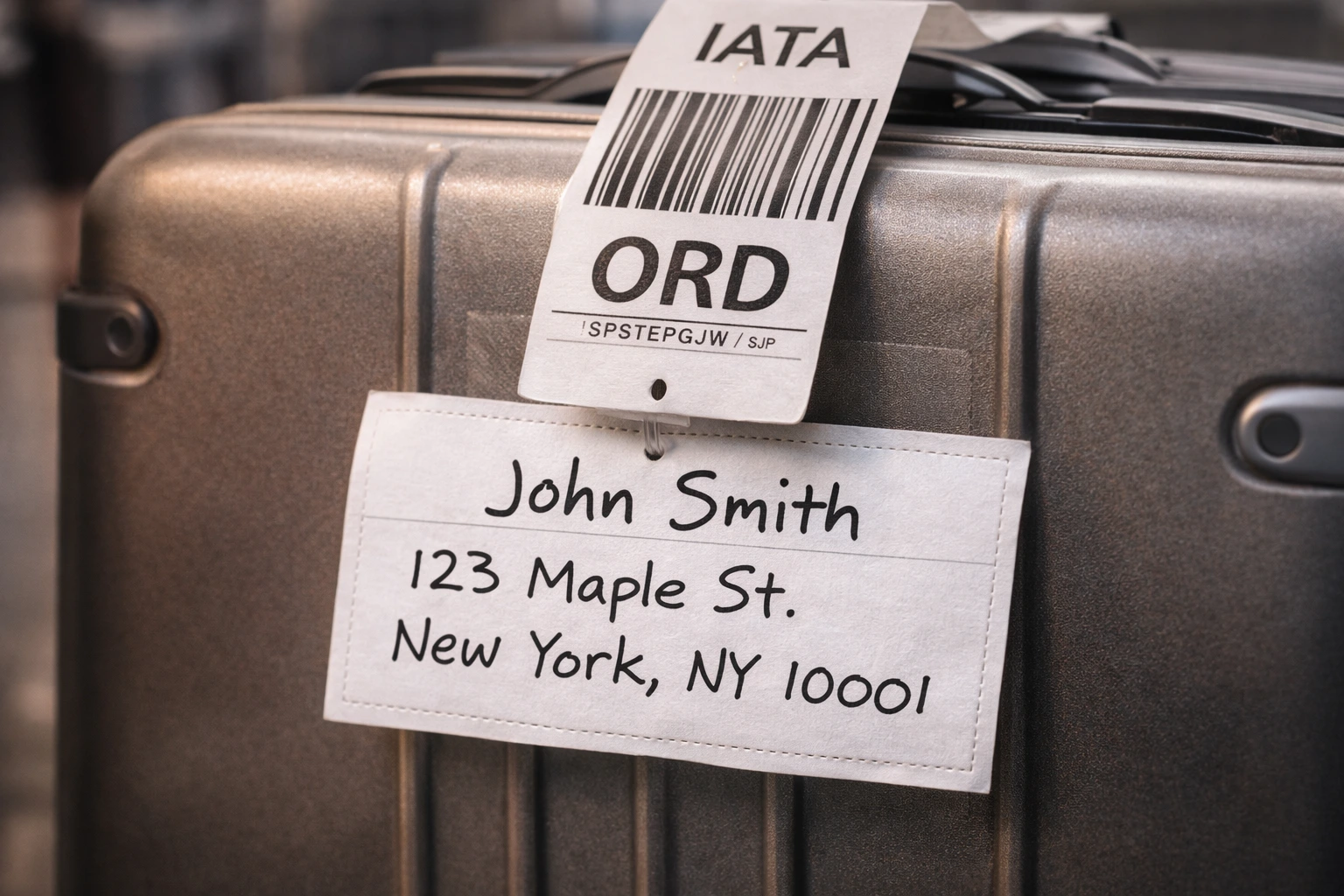
Resolution 741 – Passenger Name and Address Label is a legacy IATA passenger-service standard requiring airlines to provide name-and-address labels for checked baggage. Each label bears the passenger’s name, matching the ticket, together with a contact destination address, enabling a misplaced bag to be returned to its owner. By design, it supplements and is attached beneath the main IATA baggage tag. In practice, it ensures every checked bag carries an owner identifier, a simple measure that has long supported faster baggage recovery. Today, much of the same information may be encoded on the baggage tag itself, but the original resolution still reflects an important operational principle: visible passenger identification on the bag remains useful when systems fail or baggage is separated from digital records.
The significance of this standard lies in its simplicity. Resolution 741 does not depend on sophisticated technology, messaging infrastructure, or advanced reconciliation systems. Instead, it creates a direct human-readable connection between the checked bag and its owner. That makes it a practical fail-safe in real-world baggage operations, especially during mishandling, missed connections, tracing delays, or processing interruptions.

Historical Origin and First Publication
Resolution 741 was first adopted at the 27th IATA Passenger Services Conference and came into force on 15 December 1972. In the Passenger Services Conference Resolutions Manual, the text is associated with PSC(27)741, indicating its origin at the 27th conference. Since that time, the resolution has remained in effect without expiry and has continued to appear in subsequent manuals without substantive amendment.
That continuity matters. It shows that while baggage operations have changed dramatically over the decades, from manual tagging to barcode-based reconciliation and now RFID-supported processes, the need for a visible passenger identifier has never fully disappeared. Resolution 741 has therefore remained a stable, enduring standard rather than a temporary procedural fix. Its survival into modern baggage practice reflects the fact that even in highly automated systems, low-tech safeguards still serve a meaningful purpose.
Key Details of Resolution 741
- Resolution: 741 – Passenger Name and Address Label
- Adopted: 27th Passenger Services Conference, effective 15 December 1972
- Purpose: Ensure every checked bag carries owner identification, including name and contact details, to speed recovery of delayed or lost baggage
- Implementation: Airlines must make labels or stickers available at check-in so passengers can enter family name, initials, and optional address, phone number, or email
- Technical specification: Approximate face material width of 50.8 mm, with tag form and adhesive arrangement suitable for attachment beneath the main baggage tag
- Monitoring: Local Baggage Committees are expected to monitor availability and use of the labels by carriers at the airport
- Status: Indefinite and still relevant, though often absorbed into modern baggage tag designs
- Benefit: Adds a simple, low-tech, human-readable layer of baggage traceability that can reduce losses and passenger inconvenience
Even in a digital baggage environment, visible passenger identity remains one of the simplest and most reliable recovery tools.
Purpose and Rationale
The core goal of Resolution 741 is lost-bag recovery. By requiring a visible owner identifier on the outside of the bag, the standard ensures that a stray piece of luggage can be traced back to the passenger who checked it. If a bag arrives at the wrong city, is left unclaimed, or is separated from its digital baggage record, staff can read the label and reroute the bag to the passenger’s destination or address.
This simple measure complements modern tracking systems such as barcodes, baggage license plates, and RFID. It does not replace automated baggage handling; instead, it strengthens it. Where electronic tracking creates the primary chain of custody, the visible passenger label acts as a human-readable safety net. In other words, Resolution 741 provides resilience. It ensures that if the digital layer becomes incomplete, inaccessible, or delayed, the bag can still be linked to its owner through information carried on its exterior.
This rationale remains valid even in an era where baggage mishandling rates have fallen and the overwhelming majority of bags arrive on time. The standard is not designed for the routine case where everything works perfectly. It is designed for the exception case, the irregular operation, the missed transfer, the late-loaded bag, the bag found in a storage room, or the unclaimed item in a service area. In those cases, a visible name and address label can save time, cost, and frustration for both airline and passenger.
Why Resolution 741 still matters in modern baggage handling:
- It creates a direct owner reference on the bag itself
- It supports recovery when system-based tracing is disrupted or delayed
- It complements barcode and RFID processes with human-readable information
- It reduces the operational effort required to identify and return misrouted baggage
Technical Structure
The name-and-address label is a small adhesive tag designed to sit beneath the main baggage tag. According to the technical description associated with the standard, the label uses face material approximately 50.8 mm wide. It is structured with a form suitable for tagging and adhesive attachment, and it provides enough space for the passenger’s family name and initials, together with optional address, telephone, and email details.
The mandatory information focuses on the passenger’s family name and initials, while the optional contact data provides further recovery value. The label must also be distinguishable from the main baggage tag so that it is not confused with the official routing tag. In practice, that means it should have a different visual presentation, purpose, and placement.
Operationally, the main baggage tag supports system routing, license-plate identification, and reconciliation processes. The secondary name-and-address label serves a different function: it provides visible passenger ownership information. That distinction is important. One supports automated handling; the other supports direct human identification. Together, they make the checked bag easier to process, trace, and recover.
Although many airlines now integrate passenger data into broader baggage-tag workflows, the legacy structure still illustrates the original operational design. Airlines may still use adjacent cards, stub labels, or visible identifiers beneath the baggage tag, especially where processes continue to rely on manual intervention or mixed technology environments.
Implementation Guidelines
Resolution 741 sets out a practical implementation sequence for airlines. First, carriers are expected to make name-and-address labels or self-adhesive stickers available to passengers when they check baggage. This may happen at the check-in counter, at ticketing, or through associated baggage issuance materials.
Second, the passenger is expected to complete the label with family name matching the ticket, initials, and optionally an address, phone number, or email. The use of Latin letters is encouraged to maximize readability across international stations and different language environments.
Third, the passenger affixes the label to the outside of each checked bag. If the bag carries no identifying name already, the label becomes especially important before the bag is accepted for carriage. The placement is beneath the main IATA tag, allowing both the baggage routing information and the passenger identity information to remain secure and visible.
Fourth, airlines are expected to support the practice through their procedures and staff guidance. The process is simple, but it only works consistently when check-in staff, baggage acceptance procedures, and passenger information flows all reinforce the requirement. Resolution 741 also contemplates the use of baggage tips or advisory reminders, encouraging passengers to place their family name and contact address on the outside of their baggage.
In modern operational terms, implementation means that at each departure point, labels should be available, passengers should be reminded to complete them, and baggage acceptance procedures should align with the requirement. This makes the standard part of routine frontline handling rather than a back-office policy with no operational effect.
Benefits for Airlines
The most immediate benefit is enhanced recovery rate. When a bag is misdirected or found away from its expected route, visible passenger information makes it easier to identify the rightful owner and forward the bag correctly. This reduces the number of long-duration tracing cases and lowers the likelihood that baggage will become permanently lost.
A second benefit is operational efficiency. Ground staff, transfer teams, service-desk agents, and lost-and-found personnel can use the visible label as an additional identifier, especially when scanner access is limited or the bag is outside a structured system flow. In remote stands, disrupted transfers, or manual handling environments, the label provides a quick visual reference.
A third benefit is customer service. Faster identification and return of baggage reduces passenger inconvenience, limits complaint escalation, and supports a better recovery experience during irregular operations. A passenger whose bag is delayed but returned promptly because it carried visible contact details experiences a much different outcome from a passenger whose bag enters a prolonged tracing cycle.
Finally, the standard supports good practice and risk management. Although IATA resolutions are industry standards rather than state legislation, the underlying practice aligns well with airline obligations around care, handling quality, and baggage recovery. It also demonstrates that the carrier has taken reasonable steps to strengthen traceability of checked baggage.
Auditability and Monitoring
Resolution 741 is not intended to operate in isolation. Its compliance is reinforced through local baggage governance arrangements, particularly the role of Local Baggage Committees. These committees are expected to monitor, on a recurring basis, that name-and-address labels or stickers are available and used by all carriers serving the airport.
That gives the standard an audit dimension. The requirement is visible, easy to inspect, and straightforward to verify. Airports and committees can check whether labels are stocked at check-in positions, whether procedures require their use, and whether operational practice has drifted away from the standard.
In practical terms, monitoring may include spot checks at counters, observation of passenger baggage acceptance procedures, or review of baggage mishandling performance where visible identification played a role in successful recovery. The simplicity of the standard is one of its advantages: it is relatively easy to implement, easy to observe, and easy to audit.
Real-World Use Cases
The value of Resolution 741 is easiest to understand through operational examples. In mishandled transfer scenarios, when a bag misses a connection or is routed to the wrong station, the arrival airline can use the visible label to identify the passenger and accelerate re-routing. Instead of waiting for a full tracing cycle, staff can act on the information directly visible on the bag.
In unclaimed baggage rooms at large hubs, visible labels help staff group bags by owner, booking context, or destination. During flight irregularities or baggage backlogs, this can reduce the time required to sort unclaimed bags and begin recovery action.
At smaller or remote airports with limited baggage technology, the label may be even more important. If a bag is left behind, a local agent can use the visible destination address or hotel details to dispatch the bag correctly without relying on a fully integrated baggage IT environment.
The standard also has a passenger-awareness function. The presence of the label reminds travelers to identify their baggage externally and supports broader baggage-security messaging. It promotes a simple but effective habit: putting ownership information where airline staff can actually see it.
A useful simplified example is a passenger traveling on a multi-leg trip to Bali who attaches the Resolution 741 label showing her name and hotel address. Because of a scheduling issue, the bag misses the final flight and ends up in Singapore. The following morning, a baggage agent sees the visible label, contacts the Bali hotel, and places the bag on the first available onward flight. The bag is delivered the next day. The passenger experiences delay, but not long-term loss. That is precisely the kind of practical recovery outcome Resolution 741 was designed to support.

Amendment History
Since its introduction, Resolution 741 has remained largely unchanged. The core requirement, that airlines issue and support the use of passenger name-and-address labels on checked baggage, has persisted without major revision. Rather than being repeatedly rewritten, the standard has gradually been absorbed into routine baggage practice and, in some cases, incorporated into the design logic of modern baggage-tag systems.
That lack of significant amendment does not imply irrelevance. On the contrary, it suggests that the original principle was sound enough to survive evolving baggage technologies without losing its operational value. Visible owner identification continues to make sense regardless of whether the baggage environment is manual, barcode-driven, or RFID-enabled.
Conclusion
Resolution 741 is a decades-old but still practical standard ensuring that every checked bag carries the owner’s identity. First adopted in December 1972 at the 27th IATA Passenger Services Conference, it requires airlines to issue and support the use of passenger name-and-address labels attached beneath the main baggage tag. Technically simple, roughly 50.8 mm in format and easy to implement, it produces operational benefits far greater than its apparent size would suggest.
Its value lies in what it prevents: long tracing cycles, avoidable uncertainty, and unnecessary baggage loss. By creating a visible, human-readable ownership link on the bag itself, Resolution 741 gives airlines and airports a practical recovery tool that complements digital baggage systems rather than competing with them. In an age of increasing automation, it remains a useful reminder that some of the most effective standards in baggage operations are also the simplest.
