



Resolution 743a is an IATA Passenger Services Conference binding standard governing the forwarding of mishandled checked baggage. It requires airlines to quickly forward delayed or misrouted baggage to the passenger’s destination using the fastest available means, without any cost to the passenger. This resolution ensures that every misplaced bag is proactively tracked, routed, and delivered, minimizing inconvenience and maintaining accountability across interline airline operations.
In practical terms, Resolution 743a applies when baggage fails to travel on its intended flight. The responsible carrier must immediately take corrective action, ensuring the bag is identified, tagged, and forwarded through the airline network until it reaches the passenger.
Origin and Adoption
Resolution 743a was adopted by the IATA Passenger Services Conference and classified as a mandatory industry standard. It forms part of a broader framework of baggage handling resolutions that define how airlines manage baggage across interline journeys. The resolution remains active with indefinite validity and is periodically refined to reflect evolving operational requirements and technological capabilities.
As with other baggage resolutions, it is enforced uniformly across IATA member airlines, ensuring consistent global application regardless of carrier or airport.
Purpose and Scope
The primary purpose of Resolution 743a is to ensure that every mishandled bag is forwarded to the passenger as quickly as possible. It eliminates delays caused by unclear responsibility and establishes a clear obligation on the airline that caused the mishandling.
The scope covers all interline baggage scenarios, including missed connections, incorrect routing, and operational disruptions. The resolution ensures that once a bag is identified as delayed, it is no longer treated as static baggage but as an active delivery item requiring immediate movement.
In operational terms, this transforms baggage handling from passive recovery to proactive logistics management.
Core Process Flow
- Identification of Mishandled Baggage: Bags that fail to travel with the passenger are identified immediately.
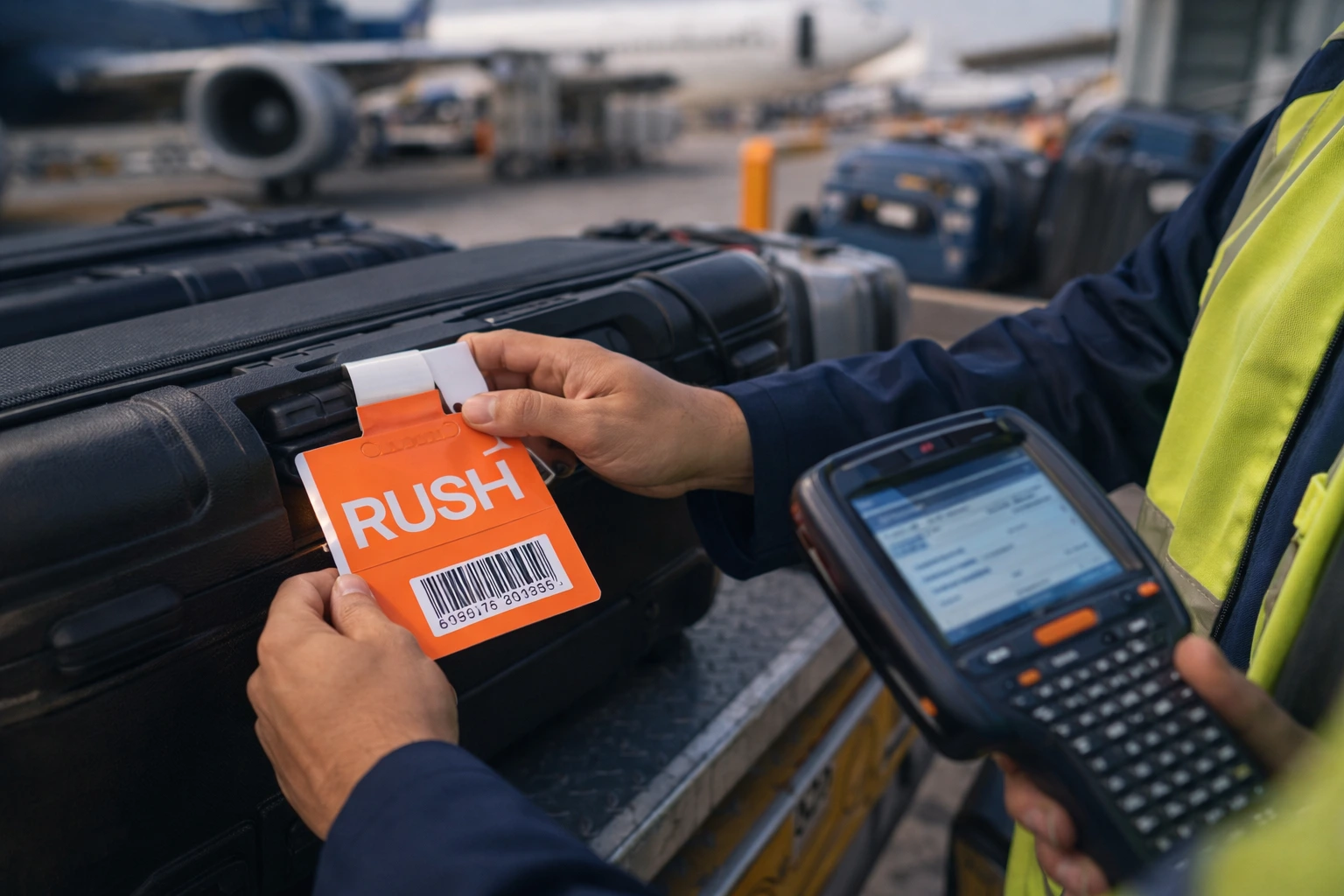
- Rush Tagging: A standardized “RUSH” baggage tag is attached to indicate priority handling.
- System Entry: The bag is entered into the global baggage tracing system for visibility across airlines.
- Routing Decision: The fastest available route to the passenger’s destination is determined.
- Forwarding: The bag is loaded onto the next available flight or transport option.
- Final Delivery: Upon arrival, the bag is delivered directly to the passenger.
Resolution 743a turns delayed baggage into an active delivery mission.
Technical Structure
Resolution 743a operates within the IATA Type B resolution framework and defines specific technical requirements for tagging, messaging, and routing. A key component is the use of standardized “RUSH” baggage tags, which include barcode identifiers that allow the bag to be tracked at each stage of its journey.
The resolution also mandates the use of global baggage tracing systems, enabling airlines to share real-time information on the bag’s status, routing, and delivery progress. This ensures seamless coordination between interline partners.
Routing logic prioritizes speed over standard scheduling, requiring airlines to use the fastest possible means to forward the bag, including alternative carriers if necessary.

Implementation Guidelines
Airlines implement Resolution 743a through structured ground handling procedures and integrated IT systems. Staff are trained to recognize mishandled baggage, apply rush tags, and initiate forwarding workflows immediately.
Coordination between airlines is critical. Once a bag is entered into the tracing system, all participating carriers can access its status and contribute to its movement toward the final destination.
Operational procedures also ensure that expedited baggage is prioritized during loading and transfer, minimizing delays at each stage of the journey.
Responsibilities and Cost Settlement
Resolution 743a clearly assigns responsibility to the airline that caused the mishandling. This airline is required to cover all costs associated with forwarding and delivery, including transportation and handling expenses.
Cost recovery is handled through established interline settlement systems, ensuring that cooperating carriers are reimbursed for their role in the forwarding process. This structure encourages accountability and promotes efficient baggage handling practices.
Benefits for Airlines and Passengers
For passengers, Resolution 743a significantly reduces the inconvenience of delayed baggage by ensuring rapid forwarding and delivery without additional charges.
For airlines, the benefits include improved customer satisfaction, reduced compensation claims, and enhanced operational efficiency. Standardized procedures also minimize disputes between carriers and provide clear accountability.
Industry-wide adoption of such standards contributes to lower mishandling rates and more reliable baggage operations overall.
Auditability and Compliance
Resolution 743a is highly auditable due to its reliance on standardized tagging and digital tracking systems. Every stage of the process—from identification to delivery—is recorded within the baggage tracing system.
Airlines can demonstrate compliance through tracking logs, delivery records, and operational reports. This transparency supports both internal performance monitoring and external regulatory oversight.
Real-World Use Cases
In real-world operations, Resolution 743a is applied whenever baggage fails to travel with the passenger. For example, a bag missing a connection is immediately tagged as rush baggage and placed on the next available flight to the destination.
Upon arrival, the bag is delivered directly to the passenger’s location, such as a hotel or residence. This ensures minimal disruption and a faster resolution compared to traditional tracing methods.
The process is consistent across global airline networks, ensuring passengers receive the same level of service regardless of route or carrier.

Conclusion
Resolution 743a is a critical component of modern baggage handling systems, ensuring that mishandled baggage is not only tracked but actively forwarded to its destination. By combining standardized tagging, global tracking systems, and clear responsibility rules, it transforms baggage recovery into a structured and efficient process.
Its impact is both operational and experiential: airlines achieve greater efficiency and accountability, while passengers benefit from faster recovery and improved service. In a complex global aviation network, Resolution 743a ensures that every delayed bag continues its journey until it reaches its rightful owner.
