



Resolution 743c defines a critical operational control in global baggage handling: the On-Hand Baggage Summary Tag. This standard ensures that any baggage not loaded, delivered, or transferred as expected is formally recorded, summarized, and tracked using a structured and standardized tag.
In practical terms, “on-hand baggage” refers to bags that remain at an airport after a flight operation—either offloaded, not transferred, or awaiting further handling. Resolution 743c mandates that these bags must not remain undocumented. Instead, they are grouped, counted, and assigned a summary tag that provides a clear, auditable record of their status.
This approach ensures visibility, accountability, and consistency across airline and ground handling operations, particularly in interline environments where multiple carriers are involved.

Origin and Publication
Resolution 743c was introduced as part of the IATA Passenger Services Conference framework to address inconsistencies in how on-hand baggage was recorded and communicated. It was formalized in the mid-2010s and incorporated into the Passenger Services Conference Resolutions Manual, where it remains active without significant amendment.
The resolution complements other baggage standards by focusing specifically on reconciliation and accountability for baggage that falls outside normal processing flows. It establishes a uniform method that all airlines and ground handlers must follow, ensuring global consistency.
Purpose and Operational Importance
The primary purpose of Resolution 743c is to ensure that all on-hand baggage is clearly documented and traceable. Without a standardized tagging system, such baggage could be recorded inconsistently, leading to discrepancies, delays, and potential losses.
By introducing the summary tag, the resolution creates a single source of truth for all on-hand baggage associated with a flight. This allows airlines and ground handlers to quickly verify bag counts, identify discrepancies, and coordinate next steps such as forwarding or storage.
In operational terms, the summary tag transforms on-hand baggage from an unmanaged exception into a controlled and traceable process.
Resolution 743c ensures no bag is left unaccounted for, even outside normal baggage flow.
Technical Structure of the Summary Tag
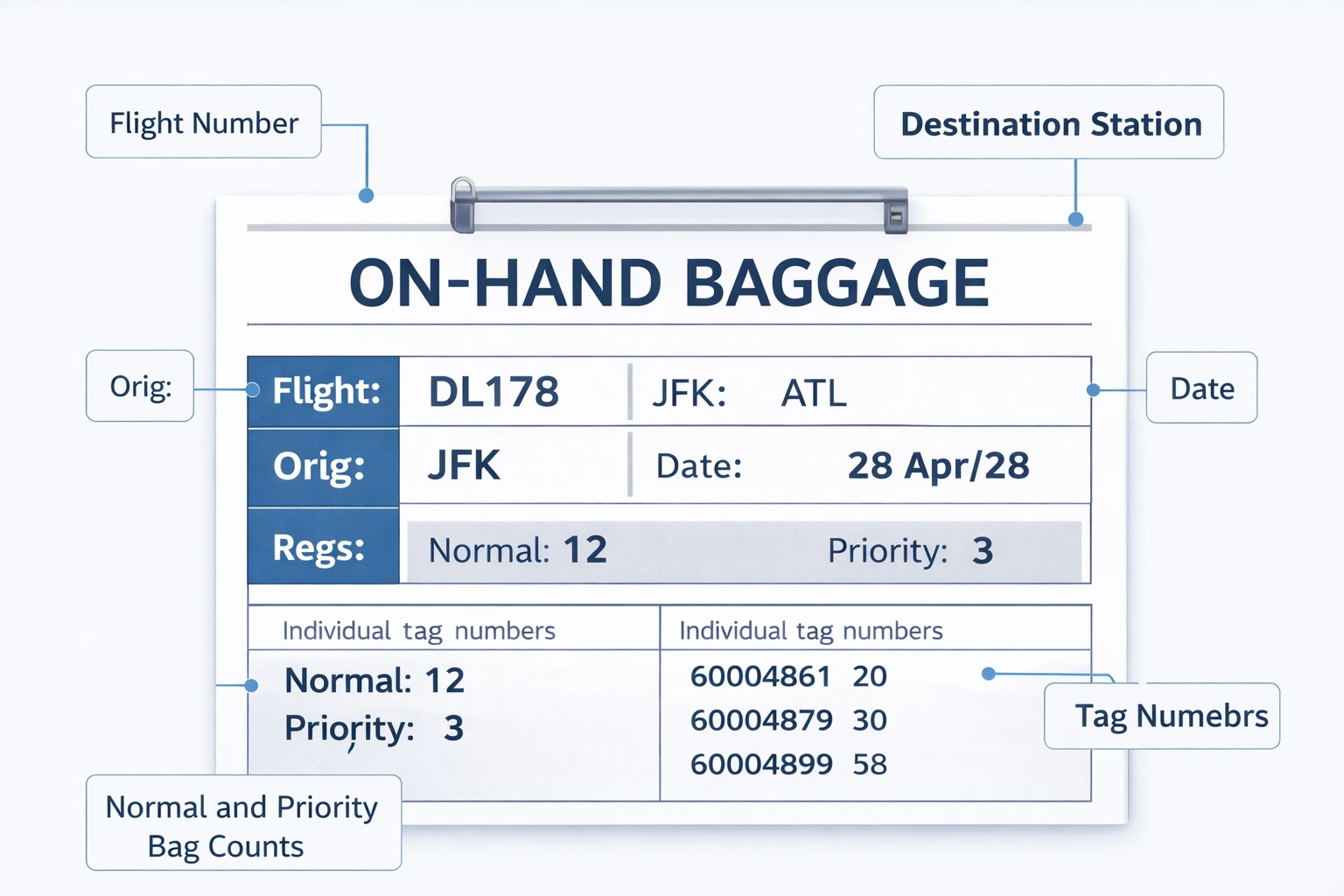
The On-Hand Baggage Summary Tag is a structured document containing key operational data related to a specific flight or handling event. It typically includes flight number, date, origin and destination, and the total number of on-hand bags.
Additional fields may include categorization of bags, such as normal or priority, as well as individual baggage tag numbers or identifiers. This allows for both aggregated and detailed tracking.
The layout follows a standardized format to ensure clarity and consistency. Each section is clearly defined, allowing handlers across different airlines and airports to interpret the information without ambiguity.
This structured approach ensures that the tag can be used both as a physical document and as a digital record within baggage tracking systems.
Implementation Guidelines
Implementation of Resolution 743c is integrated into standard ground handling procedures. When baggage is identified as on-hand, staff must immediately group the bags and generate a summary tag capturing all required information.
The tag is then attached to the baggage group, container, or associated documentation. It accompanies the baggage through any subsequent handling stages, including storage, transfer, or forwarding.
Airlines and ground handlers also log the tag data into their baggage systems, ensuring that the information is available for tracking, reconciliation, and reporting purposes.
Procedures emphasize accuracy and completeness, as the tag serves as the official record of on-hand baggage for that operation.
Benefits for Airlines
The adoption of Resolution 743c delivers significant operational benefits. It improves reconciliation by ensuring that all baggage is accounted for at each stage of the journey.
It also enhances interline coordination, as receiving carriers can immediately understand the status and quantity of on-hand baggage. This reduces delays and minimizes the risk of errors during transfer.
Additionally, the standardized approach reduces administrative overhead by eliminating the need for manual reconciliation and inconsistent reporting practices.
Airlines benefit from improved efficiency, reduced costs, and stronger operational control over baggage handling processes.
Auditability and Data Integrity
One of the key strengths of Resolution 743c is its auditability. Each summary tag serves as a documented record of on-hand baggage, providing clear evidence of how many bags were handled and their status.
This creates a reliable audit trail that can be used for internal reviews, regulatory compliance, and interline dispute resolution. The standardized format ensures that all parties interpret the data consistently.
By linking physical tags with digital records, the resolution strengthens data integrity and reduces the likelihood of discrepancies.
Real-World Use Cases
In real-world operations, Resolution 743c is applied whenever baggage does not follow its expected journey. For example, when bags are offloaded due to weight restrictions or missed connections, they are immediately classified as on-hand and tagged accordingly.
At major hub airports, on-hand baggage is grouped and processed systematically, with summary tags enabling quick reconciliation and transfer between airlines. At smaller airports, the same process ensures that even limited operations maintain consistent standards.
During interline transfers, the summary tag provides receiving carriers with a clear record of baggage counts and details, reducing confusion and enabling faster processing.

Amendment Status
Since its introduction, Resolution 743c has remained largely unchanged. Its original structure continues to meet operational requirements, demonstrating the effectiveness of its design.
While other baggage resolutions have evolved to incorporate new technologies and processes, Resolution 743c has maintained its core function as a simple and reliable control mechanism.
Conclusion
Resolution 743c establishes a clear and standardized approach to managing on-hand baggage. By requiring the use of summary tags, it ensures that all such baggage is documented, tracked, and accounted for.
Its impact extends across the entire baggage handling ecosystem, improving reconciliation, enhancing coordination, and strengthening accountability. In a complex global aviation network, Resolution 743c provides a simple yet powerful mechanism to ensure that no baggage is left unmanaged.
