Introduction
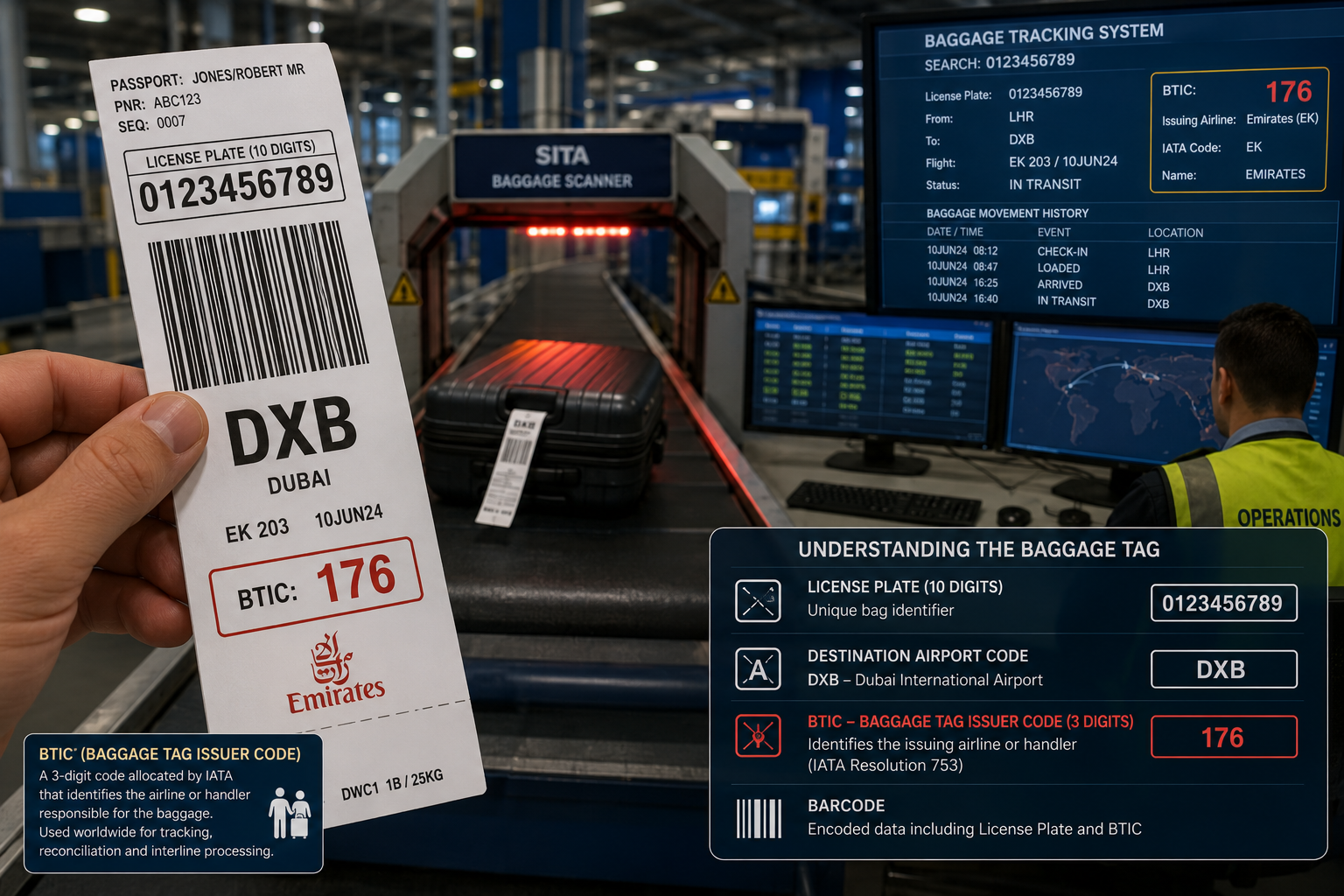
Every checked bag travelling through the global air transport system carries far more information than is visible to passengers. Beneath the familiar destination code, barcode, and baggage tag number lies a standardized identification system that enables airports, airlines, baggage handling systems, and interline partners to determine exactly which airline issued the baggage tag. This seemingly simple identifier plays a fundamental role in baggage routing, tracking, reconciliation, claims processing, and operational accountability.
The International Air Transport Association (IATA) established Resolution 769 – Baggage Tag Issuer Codes (BTIC) to standardize this critical element of baggage identification. The Resolution governs the assignment and use of the three-digit Baggage Tag Issuer Code (BTIC), a unique numeric identifier assigned by IATA to each authorized airline—or, in specific circumstances, an approved non-airline organization—that issues baggage tags. The BTIC forms the first three digits of the ten-digit baggage license plate, permanently linking every checked bag to the organization that issued its baggage tag.
Although passengers rarely notice the BTIC, it is one of the most important components of modern baggage operations. Automated baggage handling systems, Departure Control Systems (DCS), baggage tracking applications, baggage reconciliation systems, and interline messaging platforms all rely upon the BTIC to identify the issuing carrier. Because the baggage license plate remains with the bag from check-in until final delivery, the BTIC provides continuous identification throughout every stage of the baggage journey.
Resolution 769 works closely with several other IATA baggage standards. Resolution 751 defines the structure of the ten-digit baggage license plate, while Resolution 769 specifies who controls the three-digit issuer code embedded within that number. Together these standards ensure that every baggage tag issued anywhere in the world is unique, traceable, and globally recognizable. The Resolution also supports baggage messaging under Recommended Practice 1745, baggage tracking under Resolution 753, and interline baggage claims administration through Resolution 754, all of which depend upon accurate identification of the issuing carrier.
Before internationally standardized issuer codes existed, baggage identification relied more heavily on airline-specific practices, creating opportunities for confusion during interline operations and automated baggage processing. As global airline alliances expanded and passengers increasingly travelled on multi-airline itineraries, baggage handling systems required a common method of identifying the carrier responsible for issuing every baggage tag. Resolution 769 addressed this requirement by establishing centralized assignment and administration of BTICs through IATA.
Each BTIC is uniquely associated with a two-character airline designator and recorded within the IATA Airline Coding Directory. Although reservation systems commonly display the alphabetic airline designator—for example, AA for American Airlines or BA for British Airways—only the three-digit numeric BTIC appears within the printed baggage license plate. This approach simplifies barcode processing while preserving worldwide uniqueness. Automated scanners need only read the numeric code to determine the issuing carrier, regardless of language or local airport practices.
Resolution 769 also establishes strict governance over BTIC assignment and maintenance. Airlines cannot create their own issuer codes or borrow codes assigned to other carriers. Every BTIC is allocated by IATA through a controlled administrative process, ensuring that no two active organizations use the same issuer code. Periodic reviews, maintenance procedures, and code recalls help maintain the integrity of the global BTIC registry while preventing obsolete identifiers from remaining in operational use.
In today’s highly automated baggage environment, where millions of bags are processed daily across thousands of airports, Resolution 769 provides an essential layer of operational integrity. Every baggage tracking event, baggage reconciliation record, automated sortation instruction, and interline baggage message ultimately depends upon the correct identification of the issuing carrier. By standardizing the Baggage Tag Issuer Code, Resolution 769 ensures that every checked bag possesses a globally recognized identity that supports efficient baggage handling, reliable tracing, and consistent interoperability across the worldwide airline industry.
Origin and Publication
The Need for Standardized Baggage Tag Issuer Identification
As commercial aviation evolved into a highly interconnected global network, airlines increasingly relied on interline agreements that allowed passengers to check baggage through multiple carriers using a single baggage tag. While this greatly improved the passenger experience, it also introduced new operational challenges.
Every baggage tag needed to identify not only the individual bag but also the airline responsible for issuing it. Without standardized issuer identification, automated baggage systems, interline partners, and baggage tracing applications would struggle to determine which carrier created the baggage record, issued the license plate, or retained administrative responsibility for the tag.
Resolution 769 was introduced to solve this problem by establishing a globally standardized Baggage Tag Issuer Code (BTIC) assigned centrally by IATA. Instead of allowing airlines to create their own numbering systems independently, the Resolution provides a controlled international framework that ensures every issuer code remains unique and globally recognized.
Passenger Services Conference
Resolution 769 was developed under the authority of the IATA Passenger Services Conference (PSC)—now known as the Passenger Standards Conference—the international standards body responsible for passenger processing, baggage operations, reservations, ticketing, interline procedures, and airline operational interoperability.
Within this standards framework, Resolution 769 governs:
- assignment of Baggage Tag Issuer Codes;
- administration of BTIC ownership;
- maintenance of issuer code records;
- authorized use of BTICs on baggage tags;
- linkage between airline designators and numeric issuer codes.
Unlike standards governing baggage handling procedures or baggage tracking events, Resolution 769 focuses specifically on the identity of the organization that issues the baggage tag.
Adoption and Publication
Resolution 769 first appeared in the 35th edition of the Passenger Services Conference Resolutions Manual, which became effective on 1 June 2015. This indicates that the Resolution was adopted through the Passenger Services Conference process during the preceding standards cycle and has remained part of the official IATA baggage standards framework since that time.
Prior to global harmonization under IATA, the United States airline industry operated a parallel baggage numbering standard through Airlines for America (A4A) Resolution 30.69. Resolution 769 consolidated international practice under IATA administration, providing one globally recognized issuer code system for all participating airlines. Industry references frequently describe the baggage license plate concept using the combined notation A4A/IATA Resolution 30.69/769, reflecting this historical transition.
Relationship with the Baggage License Plate
Resolution 769 does not operate in isolation.
Instead, it forms an essential part of the IATA baggage license plate architecture defined elsewhere within the Passenger Services Conference standards.
The Resolution establishes that:
- every baggage tag begins with an officially assigned BTIC;
- the BTIC identifies the issuing organization;
- the BTIC becomes part of the ten-digit baggage license plate;
- the complete license plate remains unique throughout the baggage journey.
By controlling the issuer code rather than the entire baggage number, Resolution 769 allows each airline to manage its own baggage serial number ranges while preserving worldwide uniqueness.
Historical Evolution
The introduction of Resolution 769 reflected the aviation industry’s increasing dependence on automated baggage systems and global interoperability.
Earlier baggage handling practices relied more heavily on airline-specific numbering conventions. As baggage processing became increasingly automated and interline traffic expanded, airlines required a standardized method for identifying the organization responsible for issuing every baggage tag.
Central administration through IATA ensured that:
- duplicate issuer codes would not occur;
- airlines could exchange baggage information reliably;
- automated systems could identify issuing carriers consistently;
- baggage tracing systems could operate across airline boundaries.
This centralized governance remains one of the Resolution’s defining characteristics.
Relationship with the Airline Coding Directory
Every BTIC assigned under Resolution 769 is recorded within the IATA Airline Coding Directory.
The directory links:
- the airline’s two-character designator;
- the three-digit BTIC;
- associated airline coding information.
For example:
| Airline Designator | BTIC |
|---|---|
| AA | 001 |
| BA | 125 |
| LH | Assigned IATA BTIC |
Although reservation systems commonly display the alphabetic designator, automated baggage systems primarily process the numeric BTIC embedded within the baggage license plate.
Purpose
Establishing Unique Issuer Identification
The principal purpose of Resolution 769 is to ensure that every baggage tag issued anywhere in the world contains a unique identifier linking it to the airline or authorized organization that issued it.
This unique identification enables automated baggage systems to determine the issuing carrier immediately by reading the baggage license plate.
Supporting Global Traceability
Resolution 769 ensures that every checked bag remains traceable throughout its operational life.
Because the BTIC remains embedded within the baggage license plate from check-in until final baggage delivery, every baggage handling event can be associated with the issuing organization.
This traceability supports:
- baggage routing;
- baggage reconciliation;
- baggage tracking;
- baggage tracing;
- interline baggage operations;
- baggage claims administration.
Standardizing Automated Processing
Automated baggage handling systems process millions of baggage tags each day.
Resolution 769 provides these systems with a standardized method for identifying the issuing carrier without requiring interpretation of airline names or alphabetic designators.
This improves processing speed while reducing ambiguity during automated barcode scanning.
Supporting Interline Operations
Interline baggage operations depend upon consistent identification of the airline that originally issued each baggage tag.
The BTIC enables participating airlines to exchange baggage information confidently, ensuring that baggage records, tracking events, and operational messages all reference the correct issuing carrier.
Maintaining Centralized Governance
Finally, Resolution 769 establishes centralized administrative control over BTIC assignment.
By requiring all issuer codes to be allocated, maintained, reviewed, and, where necessary, withdrawn by IATA, the Resolution preserves the integrity of one of the aviation industry’s most important identification systems. It ensures that every active BTIC remains unique, authoritative, and globally recognized, supporting the continued interoperability of international baggage operations.
Operational Importance
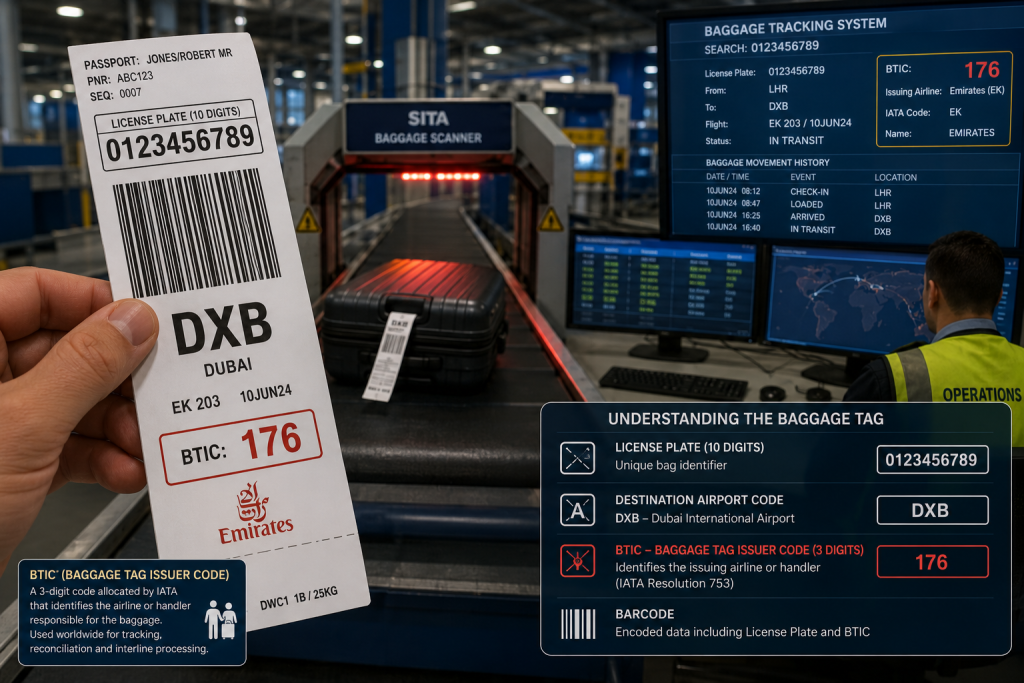
Although passengers rarely notice the three-digit Baggage Tag Issuer Code (BTIC) printed within the barcode of a baggage tag, it is one of the most important identifiers in global baggage operations. Every automated baggage handling process relies on the BTIC to determine which airline issued the baggage tag and, consequently, which airline owns the baggage record associated with the bag.
Resolution 769 transforms what might otherwise be a simple serial number into a globally recognized operational identifier. By requiring every baggage tag to contain an IATA-assigned BTIC, the Resolution enables automated systems worldwide to recognize baggage consistently regardless of where the tag was issued or which airlines subsequently transport the baggage.
Supporting Global Baggage Identification
Every checked bag must possess a unique identity.
Resolution 769 achieves this by ensuring that the issuing airline is permanently encoded within the baggage license plate.
Rather than relying upon airline names or logos—which may differ by language or branding—the BTIC provides a universally recognized numeric identifier understood by all airline operational systems.
This standardization enables baggage to move seamlessly between:
- airlines;
- airports;
- ground handlers;
- baggage handling systems;
- baggage tracking platforms.
Improving Automated Baggage Routing
Modern airports process millions of baggage items using automated sortation systems.
These systems scan baggage barcodes at multiple points throughout the baggage journey.
Each scan immediately identifies:
- the baggage license plate;
- the issuing airline;
- associated baggage records;
- routing instructions.
Because Resolution 769 standardizes the issuer code, automated systems can retrieve the correct baggage information without manual interpretation.
This significantly improves baggage sortation accuracy.
Supporting Interline Operations
Interline baggage operations depend upon continuous cooperation between airlines.
A passenger may check baggage with one airline while several other carriers subsequently transport the bag.
Throughout this journey, the BTIC identifies the airline that originally issued the baggage tag.
This supports:
- baggage messaging;
- baggage tracing;
- baggage reconciliation;
- baggage claims;
- operational accountability.
Without standardized BTICs, identifying the originating baggage record would become considerably more difficult.
Enabling Reliable Baggage Tracking
Resolution 769 provides one of the key identifiers used throughout baggage tracking systems.
Whenever baggage is scanned, the license plate—and therefore the BTIC—links operational events to the correct baggage record.
This enables airlines to maintain accurate tracking histories from:
- check-in;
- aircraft loading;
- transfers;
- arrival;
- baggage reclaim.
The Resolution therefore complements Resolution 753 by ensuring that baggage tracking events always reference the correct issuing organization.
Strengthening Operational Accountability
Because every BTIC is assigned exclusively to one airline or authorized organization, operational responsibility becomes immediately identifiable.
If baggage handling irregularities occur, investigators can determine:
- who issued the baggage tag;
- which airline created the baggage record;
- which baggage messages originated from that carrier.
This improves operational transparency throughout the baggage handling process.
Technical Structure
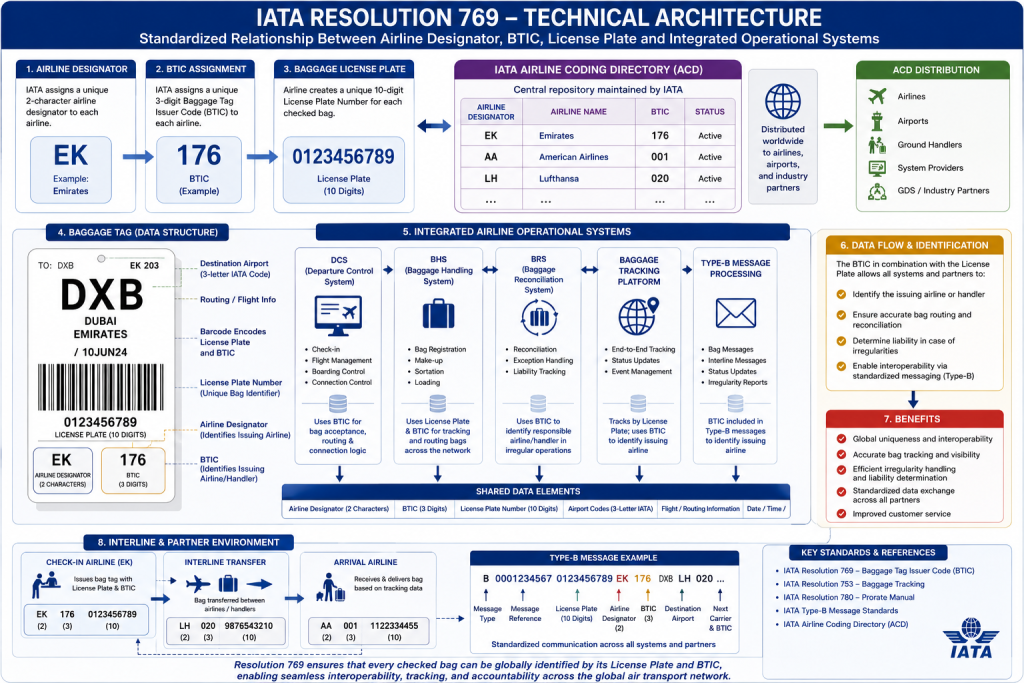
Resolution 769 establishes the complete administrative and technical framework governing Baggage Tag Issuer Codes.
Its technical architecture consists of:
- airline designators;
- numeric BTICs;
- baggage license plate structure;
- IATA Coding Directory;
- assignment procedures;
- maintenance processes;
- operational implementation requirements.
Baggage Tag Issuer Code (BTIC)
Each BTIC consists of a three-digit numeric code uniquely assigned by IATA.
Every active BTIC identifies one authorized baggage tag issuer.
The Resolution prohibits organizations from creating their own issuer codes or using codes assigned to other airlines.
Only officially allocated BTICs may appear on baggage tags.
Airline Designator Linkage
Every BTIC is associated with an airline’s two-character IATA designator.
For example:
| Airline Designator | BTIC |
|---|---|
| AA | 001 |
| BA | 125 |
| LH | Official IATA-assigned BTIC |
Although reservation systems commonly display the alphabetic designator, baggage systems process the numeric BTIC embedded within the baggage license plate.
The mapping between alphabetic and numeric identifiers is maintained within the IATA Airline Coding Directory.
Ten-Digit Baggage License Plate
Resolution 769 works directly with the baggage license plate defined under Resolution 751.
The standard license plate contains:
| Component | Description |
|---|---|
| Leading Status Digit | Indicates the license plate series (normally 0 or 1 under standard issuance) |
| Three-Digit BTIC | Identifies the baggage tag issuer |
| Six-Digit Serial Number | Uniquely identifies the baggage issued by that carrier |
Illustrative example:
0 125 345678Where:
- 0 = status digit
- 125 = BTIC
- 345678 = baggage serial number
The BTIC therefore occupies the first three digits following the leading status digit, permanently identifying the issuing airline throughout the baggage journey.
IATA Airline Coding Directory
The authoritative reference for all BTIC assignments is the IATA Airline Coding Directory.
The directory maintains:
- airline designators;
- corresponding BTICs;
- encode tables;
- decode tables;
- related airline coding information.
Operational systems use this directory to translate between alphabetic airline identifiers and numeric baggage issuer codes.
Assignment Procedures
Resolution 769 establishes centralized procedures governing BTIC assignment.
Applicants must submit requests to IATA demonstrating eligibility to issue baggage tags.
Following review, IATA:
- verifies eligibility;
- assigns an available BTIC;
- records the assignment;
- publishes the code within official industry databases.
Only after assignment may the organization begin issuing baggage tags using that BTIC.
Multiple Code Assignments
Where justified operationally, Resolution 769 permits an organization to receive more than one BTIC.
Examples may include:
- separate airline divisions;
- specialized operational units;
- approved organizational structures.
Each additional assignment remains centrally administered by IATA.
Code Maintenance
BTIC management extends beyond initial assignment.
Resolution 769 establishes procedures covering:
- annual administrative review;
- continued eligibility;
- maintenance fees;
- code recall;
- retirement of inactive codes.
Carriers must periodically confirm their continued operational need for assigned BTICs.
Inactive codes may be withdrawn and returned to the available code pool following IATA procedures.
Authorized Non-Airline Organizations
Although primarily intended for airlines, Resolution 769 also permits certain authorized non-airline organizations to receive BTICs where operationally justified.
Examples may include:
- approved ground handling organizations;
- authorized baggage service providers;
- other eligible entities approved by IATA.
Such assignments remain subject to the same administrative controls as airline-issued codes.
Implementation Guidelines
Implementation of Resolution 769 depends upon centralized administration by IATA together with consistent use by airlines, airports, and baggage system providers.
Airline Responsibilities
Each participating airline must:
- obtain an officially assigned BTIC;
- use only its assigned code;
- incorporate the BTIC into every baggage license plate;
- maintain current coding records;
- comply with IATA administrative requirements.
Airlines are prohibited from issuing baggage tags using another organization’s BTIC.
IATA Responsibilities
IATA administers the complete BTIC programme by:
- assigning new codes;
- maintaining the Airline Coding Directory;
- reviewing continued eligibility;
- recalling inactive codes;
- publishing updated coding information.
This centralized administration preserves worldwide uniqueness.
Airport Responsibilities
Airport operators ensure that:
- baggage handling systems recognize valid BTICs;
- barcode readers process standard license plates correctly;
- operational databases synchronize with official coding information.
Although airports do not assign BTICs, they depend upon their correct implementation throughout airport systems.
Technology Provider Responsibilities
Suppliers of:
- Departure Control Systems (DCS);
- Baggage Handling Systems (BHS);
- Baggage Reconciliation Systems (BRS);
- baggage tracking platforms;
- baggage messaging applications;
must maintain current BTIC reference tables consistent with the IATA Airline Coding Directory.
Operational Workflow
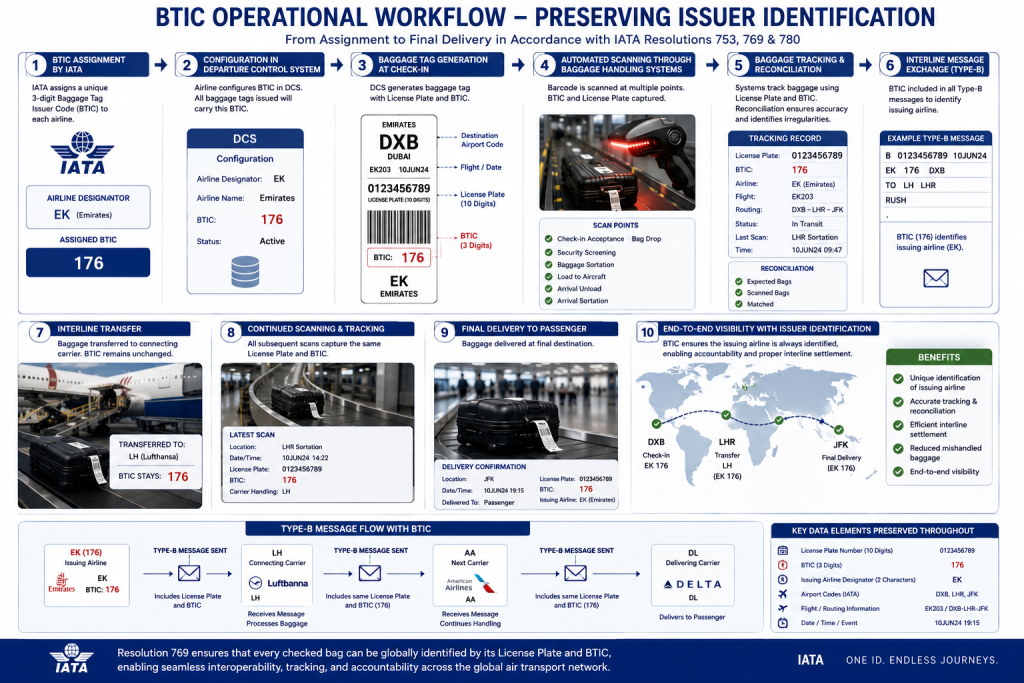
A typical Resolution 769 implementation follows these steps:
- An airline applies to IATA for a Baggage Tag Issuer Code.
- IATA reviews eligibility.
- A unique three-digit BTIC is assigned.
- The BTIC is published within the IATA Airline Coding Directory.
- Airline systems are configured with the assigned BTIC.
- Departure Control Systems generate baggage tags using the official code.
- Automated baggage handling systems scan the baggage license plate.
- Baggage tracking systems associate every scan with the issuing airline.
- Interline baggage messages exchange baggage information using the BTIC.
- The baggage reaches its final destination while retaining the same globally unique issuer identification.
System Integration
Resolution 769 integrates with virtually every baggage management system used throughout commercial aviation.
Resolution 751 – Baggage License Plate
Resolution 751 defines the overall structure of the ten-digit baggage license plate, while Resolution 769 governs the three-digit issuer code embedded within that number.
Departure Control Systems (DCS)
DCS platforms generate baggage tags containing the assigned BTIC during passenger check-in.
Baggage Handling Systems (BHS)
Automated sortation systems scan the baggage license plate and use the BTIC to identify the issuing carrier before routing baggage.
Baggage Reconciliation Systems (BRS)
BRS applications associate baggage loading records with the issuing airline through the BTIC contained within each license plate.
Type-B Baggage Messaging
Standardized baggage messages—such as BSMs, BPMs, and FWDs—reference baggage license plate numbers containing the BTIC, enabling interline partners to identify the issuing carrier accurately.
Baggage Tracking Systems
Platforms implementing Resolution 753 use the license plate, including the BTIC, as the primary identifier when recording baggage custody events and sharing tracking information between airlines.
IATA Airline Coding Directory
The Airline Coding Directory provides the authoritative mapping between two-character airline designators and three-digit BTICs, ensuring consistent interpretation across all airline operational systems.
Benefits for Airlines
Resolution 769 provides significant operational advantages by ensuring that every baggage tag issued by an airline is uniquely identifiable throughout the global baggage network. The standardized Baggage Tag Issuer Code (BTIC) enables airlines to issue baggage tags that are recognized instantly by automated systems worldwide, regardless of where the baggage subsequently travels.
Unique Global Identification
The most important benefit of Resolution 769 is the guarantee of globally unique baggage tag issuer identification.
Because every BTIC is assigned exclusively by IATA, airlines can issue millions of baggage tags without the risk of conflicting with another carrier’s numbering system.
This uniqueness is fundamental to:
- baggage identification;
- baggage routing;
- baggage tracking;
- baggage reconciliation;
- interline baggage operations.
By eliminating duplicate issuer codes, Resolution 769 supports the integrity of the worldwide baggage management system.
Improved Automated Processing
Modern airlines rely heavily on automation.
Departure Control Systems generate baggage tags, automated baggage handling systems route baggage, and baggage tracking systems record custody changes—all based on the baggage license plate.
Because the BTIC forms part of every license plate, automated systems can immediately identify the issuing airline without manual intervention.
This improves:
- baggage sortation accuracy;
- baggage tracking reliability;
- baggage message processing;
- operational efficiency.
Enhanced Interline Cooperation
Passengers increasingly travel using multiple airlines.
Resolution 769 enables interline partners to determine immediately which airline issued each baggage tag.
This supports:
- baggage forwarding;
- baggage tracing;
- baggage claims;
- baggage reconciliation;
- operational communication.
Standardized issuer identification therefore strengthens cooperation between participating airlines.
Reduced Operational Errors
Without standardized issuer codes, baggage systems would require complex translation tables or airline-specific processing.
Resolution 769 removes this complexity.
Every baggage license plate follows the same globally recognized format, significantly reducing operational errors caused by inconsistent baggage numbering.
Benefits for Airports
Airport operators benefit because virtually every airport baggage system depends upon the standardized baggage license plate structure established through Resolutions 751 and 769.
Faster Baggage Sortation
Automated barcode scanners process baggage continuously throughout airport conveyor systems.
The BTIC allows baggage handling systems to identify the issuing airline instantly before retrieving routing instructions.
This enables:
- faster baggage processing;
- more reliable sortation;
- reduced manual handling;
- improved baggage flow.
Better System Interoperability
Airports typically serve dozens of airlines simultaneously.
Because every carrier uses BTICs assigned under Resolution 769, airport baggage systems can process baggage from multiple airlines using one standardized identification framework.
This greatly simplifies airport system design and maintenance.
Improved Operational Visibility
Airport operations centres can identify baggage ownership immediately using the BTIC embedded within each baggage license plate.
This assists operational staff when investigating:
- baggage irregularities;
- delayed baggage;
- transfer failures;
- baggage tracing requests.
Benefits for Ground Handlers
Ground handling companies routinely process baggage on behalf of numerous airlines.
Resolution 769 provides an important operational advantage by standardizing baggage identification across all participating carriers.
Simplified Handling Procedures
Ground handlers no longer require airline-specific baggage numbering procedures.
Every baggage license plate follows the same internationally recognized structure.
This simplifies:
- baggage acceptance;
- aircraft loading;
- transfer handling;
- baggage delivery.
Reduced Manual Interpretation
Rather than identifying baggage through airline branding or documentation, handling personnel can rely upon automated scanners that recognize the BTIC immediately.
This reduces:
- handling errors;
- baggage misidentification;
- manual verification;
- processing delays.
Improved Operational Coordination
Because baggage handling systems, tracking systems, and operational messaging all reference the same issuer code, communication between airlines and contracted ground handlers becomes faster and more consistent.
Auditability and Compliance
Resolution 769 establishes comprehensive administrative controls governing the assignment and continued use of Baggage Tag Issuer Codes.
Centralized Administration
Unlike many operational identifiers that are managed internally by airlines, BTICs remain under centralized IATA administration.
Every assigned code is recorded within the Airline Coding Directory.
IATA maintains records covering:
- code assignment;
- ownership;
- organizational eligibility;
- administrative status;
- code recall;
- retirement.
This centralized governance ensures long-term integrity of the global BTIC registry.
Operational Note
Airlines are not permitted to create their own Baggage Tag Issuer Codes or use codes assigned to another organization. Every BTIC appearing on a baggage tag must be officially assigned and administered by IATA under Resolution 769.
Administrative Reviews
Resolution 769 requires airlines to maintain their BTIC assignments through ongoing administrative processes.
These include:
- confirmation of continued eligibility;
- maintenance of organizational information;
- payment of applicable administrative fees where required;
- notification of operational changes.
Failure to maintain compliance may result in withdrawal of the assigned issuer code.
System Auditing
Airlines routinely audit baggage systems to verify that:
- the correct BTIC appears on baggage tags;
- Departure Control Systems generate valid license plates;
- baggage messages reference valid issuer codes;
- barcode scanners interpret BTICs correctly;
- operational databases remain synchronized with the Airline Coding Directory.
These audits help preserve the reliability of automated baggage processing.
Relationship to Other IATA Standards
Resolution 769 operates within the broader IATA baggage management framework and complements several other Passenger Services Conference standards.
| Standard | Relationship to Resolution 769 |
|---|---|
| Resolution 751 – Use of the 10-Digit License Plate | Resolution 751 defines the structure of the baggage license plate, while Resolution 769 governs the three-digit Baggage Tag Issuer Code embedded within that structure. |
| Resolution 752 – Electronic Baggage Claim Receipt | Electronic baggage claim receipts display baggage license plate numbers that incorporate the BTIC assigned under Resolution 769. |
| Resolution 753 – Baggage Tracking | Every baggage tracking event recorded under Resolution 753 references the baggage license plate, including the BTIC identifying the issuing carrier. |
| Resolution 754 – Baggage Proration Profiles | Interline baggage claim investigations use the BTIC to identify the airline that issued the original baggage tag, supporting liability determination and financial settlement. |
| RP 1745 – Baggage Messaging | Standardized Type-B baggage messages exchange baggage license plate information containing the BTIC, enabling accurate interline communication. |
| Airline Coding Directory | The Airline Coding Directory provides the authoritative mapping between airline designators and officially assigned BTICs used throughout airline systems. |
Together these standards create a unified baggage identification framework that supports the complete baggage lifecycle, from check-in through final delivery and, where necessary, claims administration.
Real-World Use Cases
Passenger Check-in
A passenger checks baggage with Airline A.
The Departure Control System prints a baggage tag containing the airline’s assigned BTIC.
From that moment onward, every baggage scan references the issuing airline through the embedded issuer code.
Interline Transfer
A passenger travels on three airlines under one itinerary.
Although different carriers transport the baggage, the original BTIC remains unchanged throughout the journey.
Every participating airline can identify the issuing carrier immediately when processing baggage messages or tracking events.
Automated Baggage Sortation
An airport barcode tunnel scans the baggage license plate.
The baggage handling system reads the BTIC, retrieves the corresponding baggage record, and automatically routes the baggage toward the correct aircraft without requiring manual intervention.
Delayed Baggage Investigation
A passenger reports that checked baggage failed to arrive.
Tracing personnel use the baggage license plate to identify the issuing carrier through the BTIC before reviewing baggage tracking records generated during the journey.
Airline Merger
Two airlines merge operationally.
Resolution 769 procedures ensure that baggage tag issuer codes are administered centrally, allowing IATA to manage any future code consolidation or retirement in an orderly manner while preserving operational continuity.
Ground Handling Operations
A contracted ground handling company processes baggage for several airlines simultaneously.
Because every baggage tag contains an officially assigned BTIC, handlers can process baggage consistently regardless of the airline involved, reducing the risk of identification errors.
Industry Challenges
Although Resolution 769 has successfully standardized baggage tag issuer identification worldwide, several operational challenges remain.
Legacy Systems
Older airline and airport applications may require software modifications to support current BTIC administration procedures or updated coding information.
Maintaining compatibility across legacy platforms remains an ongoing industry challenge.
Airline Organizational Changes
Airline mergers, acquisitions, restructuring, and branding changes occasionally require updates to BTIC administration.
These changes must be carefully coordinated to avoid disrupting baggage operations.
Maintaining Global Synchronization
Because BTIC information is used by airlines, airports, ground handlers, and technology providers worldwide, updates to the Airline Coding Directory must be distributed promptly to ensure all systems remain synchronized.
Increasing Automation
Emerging technologies—including RFID-enabled baggage tags, robotic baggage handling, and AI-assisted baggage management—continue increasing reliance on accurate issuer identification.
Resolution 769 therefore becomes increasingly important as automation expands throughout the industry.
Future Outlook
Resolution 769 will continue providing the foundation for airline baggage identification as baggage operations become increasingly digital.
RFID and Digital Baggage Tags
Future electronic baggage tags and RFID-enabled baggage labels will continue incorporating the BTIC as part of the underlying baggage license plate, ensuring compatibility with existing operational systems.
Artificial Intelligence
AI-powered baggage management platforms will increasingly use BTIC information to:
- identify issuing carriers;
- analyse baggage performance;
- predict operational disruptions;
- optimise baggage routing.
Reliable issuer identification remains essential for these analytical capabilities.
Greater Automation
Next-generation airports will rely on increasingly automated baggage systems capable of processing baggage with minimal human intervention.
The standardized BTIC will remain a fundamental identifier supporting these systems.
Continued Global Standardization
As new airlines enter the market and aviation networks expand, Resolution 769 provides the governance framework necessary to assign additional issuer codes while maintaining worldwide uniqueness and interoperability.
Amendment Status
Resolution 769 remains an active standard within the IATA Passenger Services Conference framework. Since its publication in the 35th Passenger Services Conference Resolutions Manual (effective 1 June 2015), its core principles governing centralized assignment and administration of Baggage Tag Issuer Codes have remained stable. Ongoing administrative updates focus on maintaining the BTIC registry, processing new applications, managing organizational changes, and ensuring that the Airline Coding Directory accurately reflects current issuer code assignments.
Key Takeaways
- Resolution 769 establishes the international standard for Baggage Tag Issuer Codes (BTICs).
- Every BTIC is a unique three-digit numeric identifier assigned centrally by IATA.
- The BTIC forms part of the ten-digit baggage license plate used throughout global baggage operations.
- BTICs identify the airline or authorized organization that issued the baggage tag.
- Resolution 769 supports automated baggage routing, tracking, reconciliation, and messaging.
- The Airline Coding Directory maintains the authoritative relationship between airline designators and BTICs.
- Airlines may use only officially assigned issuer codes.
- Centralized administration prevents duplicate issuer codes and preserves worldwide interoperability.
- Resolution 769 works closely with Resolutions 751, 752, 753, and 754 to support end-to-end baggage management.
- The standard remains fundamental to modern automated baggage handling and interline cooperation.
Conclusion
IATA Resolution 769 provides one of the aviation industry’s most important identification standards by ensuring that every baggage tag issued anywhere in the world carries a unique, internationally recognized Baggage Tag Issuer Code. Through centralized administration by IATA, the Resolution guarantees that each issuing organization is uniquely identified, enabling airlines, airports, ground handlers, and automated baggage systems to process baggage consistently throughout the global air transport network.
Its contribution extends well beyond baggage tag administration. The BTIC underpins baggage tracking, baggage reconciliation, automated sortation, interline messaging, and baggage claims, serving as a permanent link between the checked bag and the organization that issued its license plate. By working in conjunction with Resolution 751 and related baggage standards, Resolution 769 forms a critical component of the industry’s end-to-end baggage identification framework.
As airlines continue adopting RFID-enabled baggage tags, advanced tracking technologies, and increasingly automated baggage handling systems, the standardized issuer identification established by Resolution 769 will remain indispensable. Its enduring value lies in providing a stable, globally recognized foundation for baggage interoperability, ensuring that every checked bag can be accurately identified, processed, and traced throughout its entire journey.